The Charpy impact test is a critical material testing procedure used worldwide to measure the toughness and notch sensitivity of steel and other materials. This test evaluates how materials behave under sudden, high-velocity loading at various temperatures, providing essential data for structural integrity assessment in demanding applications. Two primary international standards govern this test: ISO 148 (European standard) and ASTM A370 (American standard), each with specific procedural differences and acceptance criteria that influence material qualification and design decisions.
Purpose and Significance of Charpy Testing
The Charpy impact test determines a material's ability to absorb energy and resist brittle fracture under rapid loading. Steel exhibits different behavior at various temperatures, with a transition from tough (ductile) behavior to brittle behavior at lower temperatures. This transition temperature is critical for structural applications exposed to low-temperature environments, such as offshore structures, arctic pipelines, military installations, and nuclear facilities. Understanding this behavior prevents catastrophic failures like the brittleness-induced failures of welded ships in World War II.
- Assesses material toughness and impact resistance
- Identifies transition temperatures for ductile-to-brittle behavior
- Qualifies materials for critical infrastructure applications
- Supports design decisions for temperature-dependent loading scenarios
- Verifies material compliance with contract specifications
ISO 148 Standard: European Specification
ISO 148 is the European standard for Charpy pendulum impact testing, establishing consistent procedures across EU member states and international applications. The standard specifies detailed requirements for specimen preparation, testing equipment calibration, temperature control, and result interpretation. ISO 148 defines three types of Charpy test specimens: Type A (full-size 55x10x10mm), Type B (sub-size 40x10x10mm), and Type C (sub-size 27.5x10x10mm). The test requires precise temperature control within ±2°C for each measurement point, typically evaluating specimens at multiple temperatures (-40°C, -20°C, 0°C, 20°C, and above) to establish the transition curve.
- Uses standardized specimen dimensions: 55x10x10mm (Type A)
- Requires 10mm V-notch depth with specific geometry
- Temperature control: ±2°C precision mandated
- Supports multiple temperature testing for transition curve establishment
- Results reported in Joules (J) with detailed documentation requirements
ASTM A370 Standard: American Specification
ASTM A370 is the American Society for Testing and Materials standard for mechanical testing of steel products. While similar in principle to ISO 148, ASTM A370 contains procedural variations that reflect North American engineering practice and historical material development. The standard permits both full-size and sub-size specimens but traditionally emphasizes full-size specimens (55x10x10mm). ASTM A370 specifies tolerance ranges for specimen dimensions and allows testing at specific temperature intervals rather than continuous temperature mapping. The standard integrates Charpy testing with other mechanical properties like tensile strength, yield strength, and elongation.
- Standard specimen: 55x10x10mm with ±0.5mm tolerances
- Permits sub-size specimens under specific conditions
- Temperature tolerance: ±2°C during test execution
- Typically focuses on specific temperatures: -40°C, -20°C, 0°C
- Results reported in foot-pounds (ft-lbf) or Joules
Key Differences Between ISO 148 and ASTM A370
While both standards measure impact toughness using the same pendulum principle, significant procedural differences exist. ISO 148 emphasizes comprehensive temperature mapping with wider test temperature ranges to fully characterize the ductile-to-brittle transition curve. ASTM A370 typically focuses on fewer discrete temperature points, reflecting traditional North American material acceptance practice. Specimen dimension tolerances differ slightly, with ISO 148 maintaining tighter dimensional control. Reporting requirements vary, with ISO 148 requiring detailed documentation of specimen orientation, test temperature, and energy absorption values, while ASTM A370 allows more flexible reporting formats. Equipment calibration frequencies and procedures also diverge, with ISO 148 requiring more frequent verification.
- Temperature mapping: ISO 148 (comprehensive) vs ASTM A370 (discrete points)
- Specimen tolerances: ISO 148 (tighter ±0.25mm) vs ASTM A370 (±0.5mm)
- Reporting format: ISO 148 (detailed) vs ASTM A370 (flexible)
- Equipment calibration: ISO 148 (more frequent) vs ASTM A370 (periodic)
- Acceptance criteria: Different threshold values for project compliance
Test Procedure and Equipment
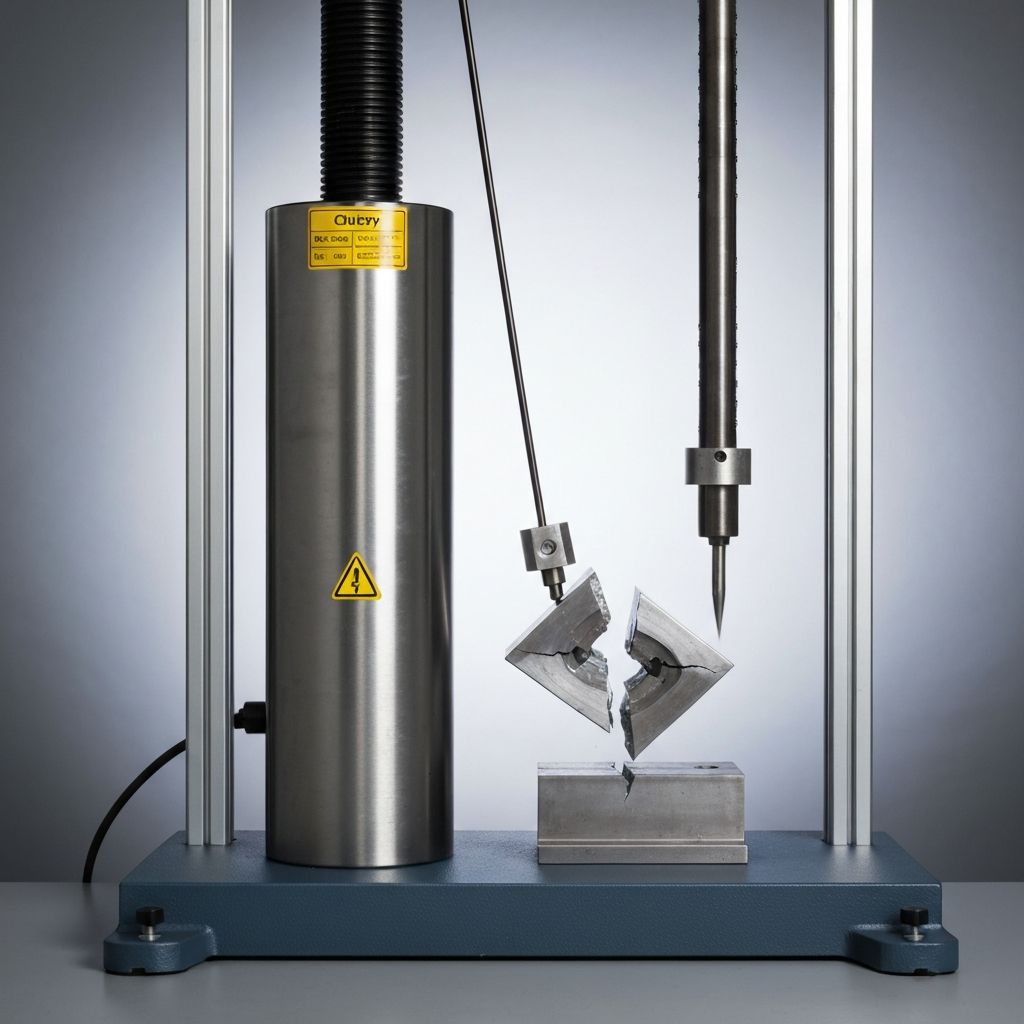
Both standards employ a Charpy pendulum impact machine where a hammer strikes a notched specimen held horizontally. The machine measures the energy absorbed by the specimen during fracture, calculated from the height difference of the pendulum before and after impact. Modern equipment includes computerized data acquisition, automated temperature control chambers, and data logging systems. Specimens are carefully prepared with precise V-notch geometry (typically 2mm depth, 45-degree angle) to ensure consistent stress concentration. Prior to testing, specimens are conditioned at the target temperature for 10-15 minutes to achieve thermal equilibrium. The test is rapid (typically 150-200 milliseconds) and produces two critical measurements: the energy absorbed (in Joules or ft-lbf) and qualitative fracture appearance (percent fibrous versus crystalline).
Interpreting Results and Transition Temperature
Impact test results are plotted against temperature to establish a transition curve showing the shift from tough to brittle behavior. The transition temperature is identified as the temperature at which the material absorbs approximately 50% of its maximum energy, though different definitions exist (ISO 148 defines it as 28J absorption). Materials exhibiting sharp transitions require careful temperature control during service, while materials with gradual transitions provide better safety margins. The Energy-Temperature curve guides engineering decisions about acceptable service temperatures. High-energy absorption at low temperatures indicates excellent toughness, while rapid energy drop signals brittle transition onset.
Conclusion
Material toughness verification is essential for structural safety in demanding applications. Our engineering consulting team supports design validation and material specification across military, nuclear, and critical infrastructure projects. Connect with us to discuss your impact testing requirements, material qualification strategies, and design assurance protocols.
Related Testing Services
- Tensile Strength Testing
- Hardness Testing
- Bend Testing
- Weld Testing
Applicable Standards
Professional Engineering Support
This testing and verification work is part of comprehensive construction management and quality assurance services provided by our architectural and engineering consulting team. We support project management, quality control, and commissioning across military, nuclear, infrastructure, and commercial sectors.
Request Engineering Services