ASTM A615/A615M—Standard Specification for Deformed and Plain Carbon-Steel Bars for Concrete Reinforcement—is the internationally recognized specification governing the manufacture, quality, testing, and acceptance of carbon-steel reinforcing bars used in reinforced concrete construction throughout North America and globally. Originally adopted in 1968 and continuously updated to incorporate research and field experience, ASTM A615/A615M-20 establishes rigorous requirements for chemical composition, mechanical properties, deformation geometry, surface quality, dimensional accuracy, and comprehensive testing protocols that ensure reinforcing steel meets structural performance demands and provides reliable tension capacity in concrete members. The specification addresses four distinct minimum yield strength grades (40, 60, 80, and 100 ksi), deformation pattern requirements ensuring adequate bond development, tensile strength and elongation criteria providing ductility and warning before failure, bending requirements demonstrating material workability, and detailed testing and acceptance procedures. Understanding ASTM A615 requirements is essential for structural engineers, detailers, concrete contractors, reinforcing steel suppliers, and quality assurance personnel to ensure delivered reinforcement meets specification compliance and performs reliably under design loads throughout the structure's service life.
Scope and Reinforcement Grade Designations
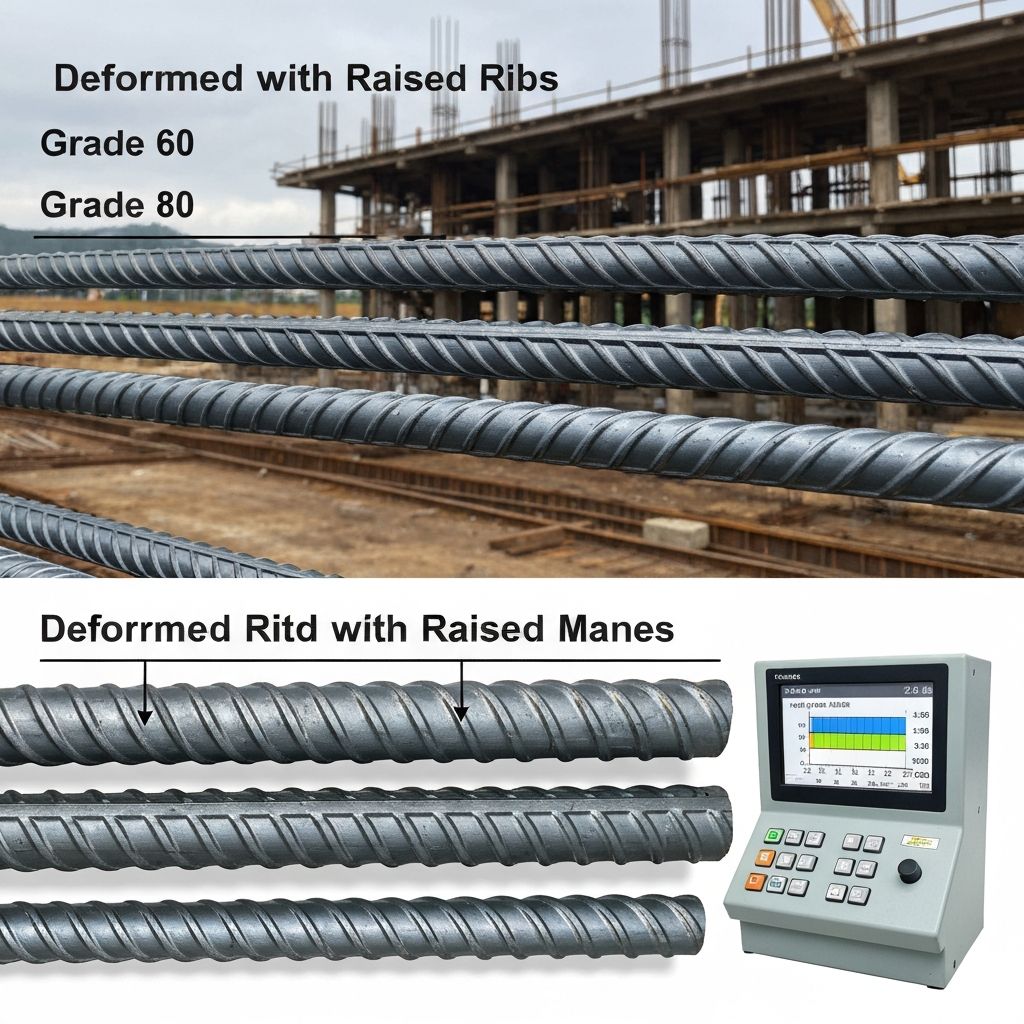
ASTM A615/A615M covers deformed and plain carbon-steel bars in cut lengths and coils for concrete reinforcement in standard applications. The specification establishes four minimum yield strength grades: Grade 40 [280 MPa] with 40,000 psi minimum yield strength, Grade 60 [420 MPa] with 60,000 psi minimum yield strength, Grade 80 [550 MPa] with 80,000 psi minimum yield strength, and Grade 100 [690 MPa] with 100,000 psi minimum yield strength. Grade 100 bars, introduced in 2015, represent higher-strength reinforcement suitable for applications requiring reduced member sizes and decreased longitudinal reinforcement. However, Grade 100 bars have a lower ratio of tensile to yield strength (1.15) compared to lower grades (1.25-1.50), reducing the margin of safety and warning of failure after yielding, particularly in beam and slab applications where tensile strength governs. For Grade 100 bars, mechanical and welded splices must meet minimum 115,000 psi tensile strength requirements (different from lower grades requiring 125% of yield strength). The specification provides bar designation numbers (sizes 3 through 20) with corresponding nominal weights, dimensions, and deformation requirements. Plain bars are furnished up to 2½ inches diameter in all four grades, with ductility requirements based on the nearest smaller deformed bar size.
Bar Sizes, Designation System, and Deformation Patterns
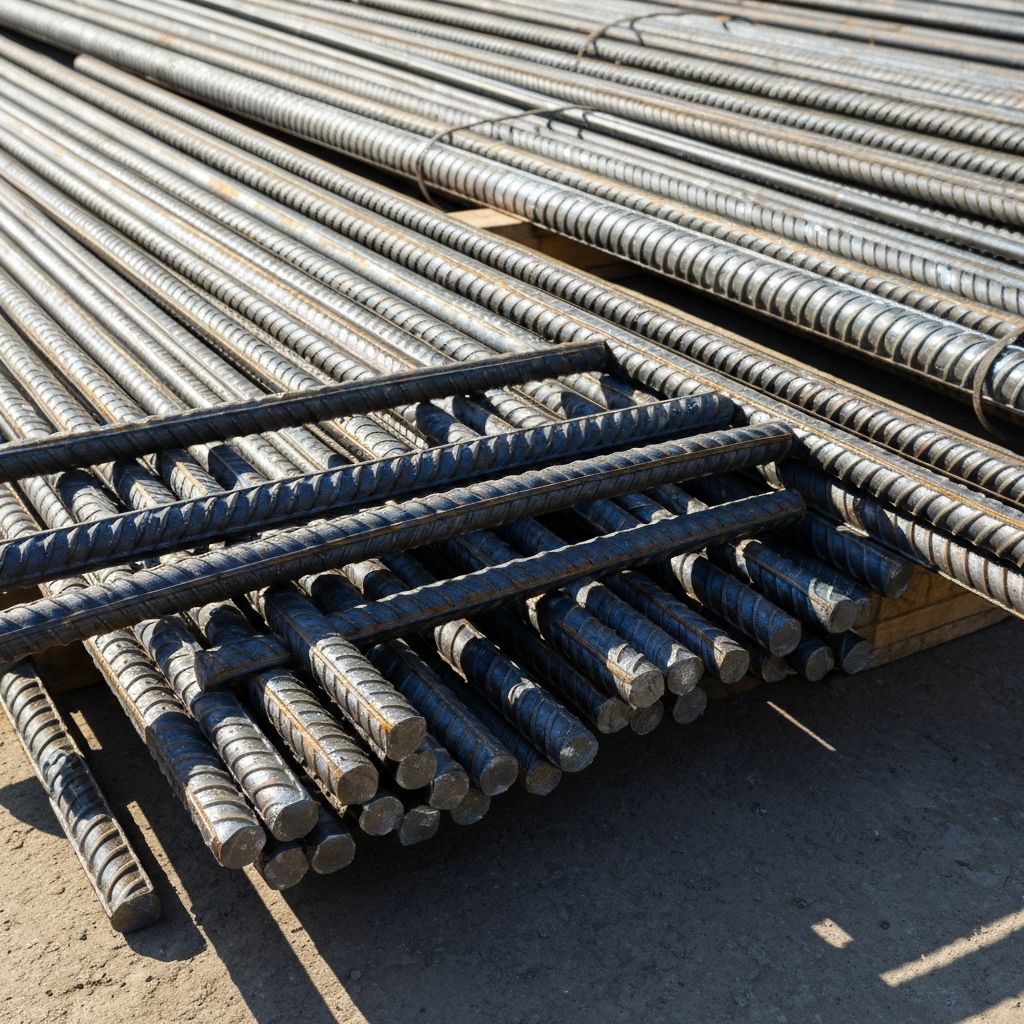
ASTM A615 provides 12 standard deformed bar sizes with designation numbers 3, 4, 5, 6, 7, 8, 9, 10, 11, 14, 18, and 20 (metric equivalents: 10, 13, 16, 19, 22, 25, 29, 32, 36, 43, 57, and 64 mm). Each size has precisely defined nominal dimensions: diameter ranges from 0.375 inches for No. 3 bars to 2.500 inches for No. 20 bars; cross-sectional areas from 0.11 square inches (71 mm²) to 4.91 square inches (3167 mm²); nominal weights from 0.376 lb/ft for No. 3 bars to 16.69 lb/ft for No. 20 bars. Deformations (ribs) are mandatory on the surface of deformed bars to inhibit longitudinal movement relative to surrounding concrete. Deformation requirements include: (1) uniform spacing along the bar at maximum distances specified in Table 1 (ranging from 0.262 to 1.75 inches depending on size); (2) minimum average height of ribs (0.015 to 0.113 inches depending on size); (3) angle orientation with respect to bar axis of minimum 45°, with specified reversal patterns when angle is 45-70°; (4) overall rib coverage where gaps between deformation ends shall not exceed 12.5% of nominal bar perimeter, with cumulative gap summation not exceeding 25%. These stringent deformation specifications ensure consistent bond development between steel and concrete and predictable structural performance.
Chemical Composition Requirements and Material Specification
ASTM A615 requires that all reinforcing bars be rolled from properly identified heats of mold-cast or strand-cast steel made by any commercially accepted steel manufacturing process. Chemical analysis of each heat must determine percentages of carbon, manganese, phosphorus, and sulfur in accordance with ASTM A751 (Test Methods, Practices, and Terminology for Chemical Analysis of Steel Products). The critical chemical composition restriction is phosphorus content, which must not exceed 0.06% (60 ppm) to ensure adequate weldability and ductility. Product check analysis conducted by the purchaser must not exceed the specified phosphorus limit by more than 25%, permitting 0.075% maximum for check analysis. Steel bars containing alloy additions from Association for Iron and Steel Technology (AIST) or Society of Automotive Engineers (SAE) alloy series are explicitly permitted if resulting products meet all other specification requirements, providing flexibility for manufacturers to use recycled steel and optimize properties. The specification does not restrict total alloy content; compliance is verified through successful achievement of mechanical property requirements (yield strength, tensile strength, elongation, bend performance) rather than prescriptive alloy chemistry.
Tensile Property Requirements and Mechanical Strength Grades
ASTM A615 establishes precise tensile property requirements differentiated by grade and bar size. For Grade 60 [420 MPa] bars, minimum yield strength is 60,000 psi, minimum tensile strength is 80,000 psi, and minimum ratio of actual tensile to actual yield strength is 1.10; elongation requirements vary by size from 12% for small bars (sizes 3-8) to 7% for large bars (sizes 14, 18, 20). For Grade 80 [550 MPa], minimum yield is 80,000 psi, minimum tensile is 100,000 psi, ratio 1.10, with elongation 8-7% by size. For Grade 100 [690 MPa], minimum yield is 100,000 psi, minimum tensile is 115,000 psi, ratio 1.10, with elongation 7-6% by size. Grade 40 [280 MPa] bars are available only in sizes 3-6, with 40,000 psi yield, 60,000 psi tensile, ratio 1.10, and 11-12% elongation. Yield strength is determined by either the drop-halt method for well-defined yield points or the 0.2% offset method for work-hardened steel without distinct yield points. Test specimens must be full-section bar as rolled; tension specimens require 8-inch gage length with minimum two bar diameters distance from gage marks to grip contact. Straightening of coil-supplied specimens prior to testing is mandatory to avoid measurement errors from residual bending.
Bending Requirements and Ductility Verification
ASTM A615 requires bend testing to verify material ductility and workability under cold bending—a critical requirement for reinforcing steel that must bend around formwork, be shaped into cages, and accommodate detailing requirements. Bend test specimens are subjected to specified degrees of bending around defined pin diameters with requirements varying by grade and size. For Grade 60 bars, pin diameters range from 3½d (where d equals nominal diameter) for small sizes to 9d for large sizes; Grade 80 requires 5d minimum for sizes 3-6 and 7d for larger sizes; Grade 100 requires 5d for small bars and 7d for medium/large sizes. Test specimens must withstand bending without cracking on the outside radius. The bend tester apparatus must provide continuous uniform force throughout bending, unrestricted specimen movement at contact points, and close wrapping around the rotating pin. Alternative methods per ASTM E290 are permitted, including placement across rotating bearings with fixed rounded-tip mandrel. Failure to pass bend testing indicates material brittleness or inadequate ductility potentially resulting from excessive carbon content, work-hardening from fabrication, or improper heat treatment. Bend test retests are permitted when initial failures are attributed to material reasons (not mechanical/flaws).
Deformation Measurement and Dimensional Verification
ASTM A615 establishes precise procedures for measuring and verifying deformation dimensions to ensure consistent bond development. Average deformation spacing is measured by recording length of minimum ten spaces and dividing by number of spaces—measurement begins from point on one deformation to corresponding point on the final deformation, excluding marking symbols. Average deformation height is determined from measurements on not less than two typical deformations, with three measurements per deformation: one at center of deformation length and two at quarter-length points. Gap measurements (distance between deformation ends measured as chord) and cumulative gap summation must comply with limits in Table 1. Weight [mass] determination uses nominal bar weights per unit length from Table 1; test specimens when measured and rounded per ASTM E29 shall be at least 94% of applicable nominal weight—overweight bars are never cause for rejection. Deformation deficiencies in spacing, height, or gap do not constitute rejection cause unless established by testing on each lot (all bars of one size and deformation pattern in individual shipping release) that typical dimensions fail to conform to minimum requirements. At least ten adjacent deformations on each bar side must be measured; rejection cannot be based on fewer than ten deformations.
Surface Quality, Finish, and Allowable Surface Conditions
ASTM A615 requires that reinforcing bars be free of detrimental surface imperfections that would compromise strength, bonding, or durability. Rust, mill scale, seams, and surface irregularities are not cause for rejection provided weight, dimensions, cross-sectional area, and tensile properties of hand wire-brushed test specimens meet specification requirements. This provision recognizes that surface oxidation is common in reinforcing steel and does not affect structural performance if base material properties are adequate. However, surface imperfections other than minor rust/scale—including laps, seams, scabs, slivers, cooling/casting cracks, and mill/guide marks—are considered detrimental when specimens containing such flaws fail to conform to tensile or bending requirements. Deformed bars intended for epoxy coating applications should have surfaces with minimum sharp edges to achieve proper coating coverage; particular attention must be given to bar marks and deformations where coating difficulties occur. Deformed bars intended for mechanical or butt-weld splicing may require certain roundness characteristics to adequately achieve splice strength requirements. Visual inspection combined with mechanical testing (tension and bend) provides comprehensive surface quality verification.
Mechanical Testing Program and Quality Control
ASTM A615 establishes mandatory testing requirements to verify reinforcing steel conformance with all specification criteria. One tension test and one bend test must be performed on each bar size rolled from each heat of steel. Additionally, one set of dimensional property tests including bar weight and deformation spacing, height, and gap must be performed on each bar size rolled from each heat. Test specimens shall be conducted in accordance with ASTM A370 (Test Methods and Definitions for Mechanical Testing of Steel Products); any conflicts between A615 and A370 requirements result in A615 provisions taking precedence. Tension test specimens must be full-section bar as rolled; tension tests are conducted on 8-inch gage lengths with stress determinations based on nominal bar area. Bend test specimens are similarly full-section bars; requirements vary by grade and size per Table 3. When coil-supplied reinforcement undergoes straightening, careful technique is essential to avoid cold-work effects that increase yield strength and reduce elongation.
Retest Provisions and Acceptance Criteria
ASTM A615 permits limited retesting when initial test results fall slightly below specification limits, recognizing that material borderline failures may result from testing variability rather than material deficiency. When tension test results fall below requirements but within 2,000 psi of required tensile strength, 1,000 psi of required yield strength, or two percentage units of required elongation, retest on two additional random specimens from the lot is permitted—both retest specimens must fully meet all requirements for acceptance. Similarly, if bend test failures occur for material reasons rather than mechanical/flaws, retest on two random specimens is permitted at air temperature minimum 60°F. Weight test failures (below 94% nominal weight) permit retest on two random specimens unless flaws are detected. Invalid test results are discarded and new specimens are tested; invalid tests occur when: (1) elongation fracture location is outside middle half of gage length; (2) mechanical failure of testing equipment or improper specimen preparation; or (3) flaws are detected in test specimen. This retest approach acknowledges that single tests may not always represent lot characteristics while maintaining rigorous quality through mandatory retesting.
Chemical Analysis Reporting and Material Certification
ASTM A615 requires comprehensive material test reporting documenting chemical analysis, tensile properties, and bend test results on a per-heat basis. Chemical analysis reports must include percentages of carbon, manganese, phosphorus, and sulfur determined by ASTM A751 methods; tensile properties reporting includes yield strength, tensile strength, elongation values, and actual tensile-to-yield ratio; bend test results must indicate performance for each bar size tested from the heat. Material test reports, certificates of inspection, or similar documents transmitted electronically via electronic data interchange (EDI) systems carry equivalent validity to facility-printed documents provided EDI content meets specification requirements and EDI agreements exist between purchaser and manufacturer. Organizations submitting EDI transmissions accept full responsibility for report content regardless of absence of handwritten signature. This provision facilitates modern supply-chain documentation while maintaining accountability for material quality. All test reports must be available to the purchaser for records verification and potential future disputes regarding material performance.
Marking and Bar Identification Requirements
ASTM A615 requires that deformed bars be identified with a distinguishing set of marks legibly rolled onto the surface of one bar side to denote specific information in prescribed order. Mandatory identification marks include: (1) Point of Origin—letter or symbol established as manufacturer's mill designation; (2) Size Designation—Arabic number corresponding to bar designation number (3-20); (3) Type of Steel—letter S indicating production per A615, or letters S and W indicating conformance to both A615 and A706/A706M (low-alloy) specifications; (4) Minimum Yield Strength Designation—for Grade 60 bars, either number 60 or single continuous line through at least five deformation spaces offset from bar center; Grade 80 bars: number 80 or three continuous lines; Grade 100: number 100, four lines, or letter C; no marking required for Grade 40 bars. Plain bars must be tagged (not rolled-marked) for grade designation. Metric equivalent bars can be substituted where Grade 280 metric bars replace Grade 40 inch-pound, Grade 420 replaces Grade 60, Grade 550 replaces Grade 80, and Grade 690 replaces Grade 100. Bundle identification must include manufacturer's heat or test identification number; when bundle contains bars from consecutive heats of same nominal composition, both heat numbers must be identified.
Ordering Information and Contract Specifications
Purchasers must provide complete ordering information to ensure accurate reinforcement delivery. Mandatory order requirements include: (1) quantity in weight/mass; (2) deformed or plain bar specification; (3) bar designation number or nominal diameter; (4) cut lengths or coils; (5) grade (40, 60, 80, or 100); (6) ASTM designation A615 or A615M with year of issue. Additional optional requirements may be specified including: inspection procedures, requirements for bars in each bundle from single heat, special package marking, requirements for alternative bar sizes (Annex A1), requirements for bars for mine roof/rock bolts (Annex A2—Grade 75 [520 MPa]), or other special requirements. Purchasers must ensure local market availability of specified grades and sizes; Grade 100 bars and largest bar sizes (No. 18, 20) may require special ordering and fabrication approval. Clear communication of all requirements in purchase orders prevents ambiguity and disputes regarding delivered material.
Packaging, Marking, and Shipment Requirements
ASTM A615 requires that reinforcing bars be packaged, marked, and loaded for shipment in accordance with ASTM A700 (Practices for Packaging, Marking, and Loading Methods for Steel Products for Shipment). Bars must be properly separated and tagged with manufacturer's heat or test identification before shipment. When specified in purchase orders or for U.S. Government procurement, additional marking must comply with MIL-STD-129 (military agencies) or Federal Standard No. 123 (civil agencies). Manufacturer shall maintain records of heats contained in each bundle, particularly when bundle comprises bars from multiple consecutive heats. Detailed handling and storage requirements ensure bars remain protected from damage, corrosion, and contamination throughout transit. These packaging and marking provisions facilitate material traceability, enable lot recall if quality issues emerge, and ensure inspection personnel can verify material conformance to specified criteria.
Conclusion
ASTM A615/A615M represents the definitive standard for carbon-steel reinforcing bars in reinforced concrete construction, establishing rigorous requirements for chemical composition, mechanical properties, deformation geometry, and quality assurance. Successful concrete reinforcement projects depend on comprehensive understanding of grade designations, mechanical property requirements, deformation specifications, testing protocols, and acceptance criteria. VSG provides complete reinforcing steel quality assurance including mill certification verification, mechanical property testing (tension/bend testing), chemical analysis verification, dimensional/deformation measurement, material certification review, and ASTM A615 compliance documentation. Our experienced team assists structural engineers, contractors, and material suppliers in ensuring reinforcement meets specification requirements and performs reliably under design loads. Contact VSG for reinforcing steel quality assurance, compliance verification, and construction materials support for your concrete reinforcement projects.
Related Testing Services
- Tensile Testing
- Yield Strength Determination
- Bend Testing
- Elongation Testing
- Chemical Analysis
- Weight/Mass Verification
- Deformation Measurement
- Weldability Assessment
Applicable Standards
Professional Engineering Support
This testing and verification work is part of comprehensive construction management and quality assurance services provided by our architectural and engineering consulting team. We support project management, quality control, and commissioning across military, nuclear, infrastructure, and commercial sectors.
Request Engineering Services