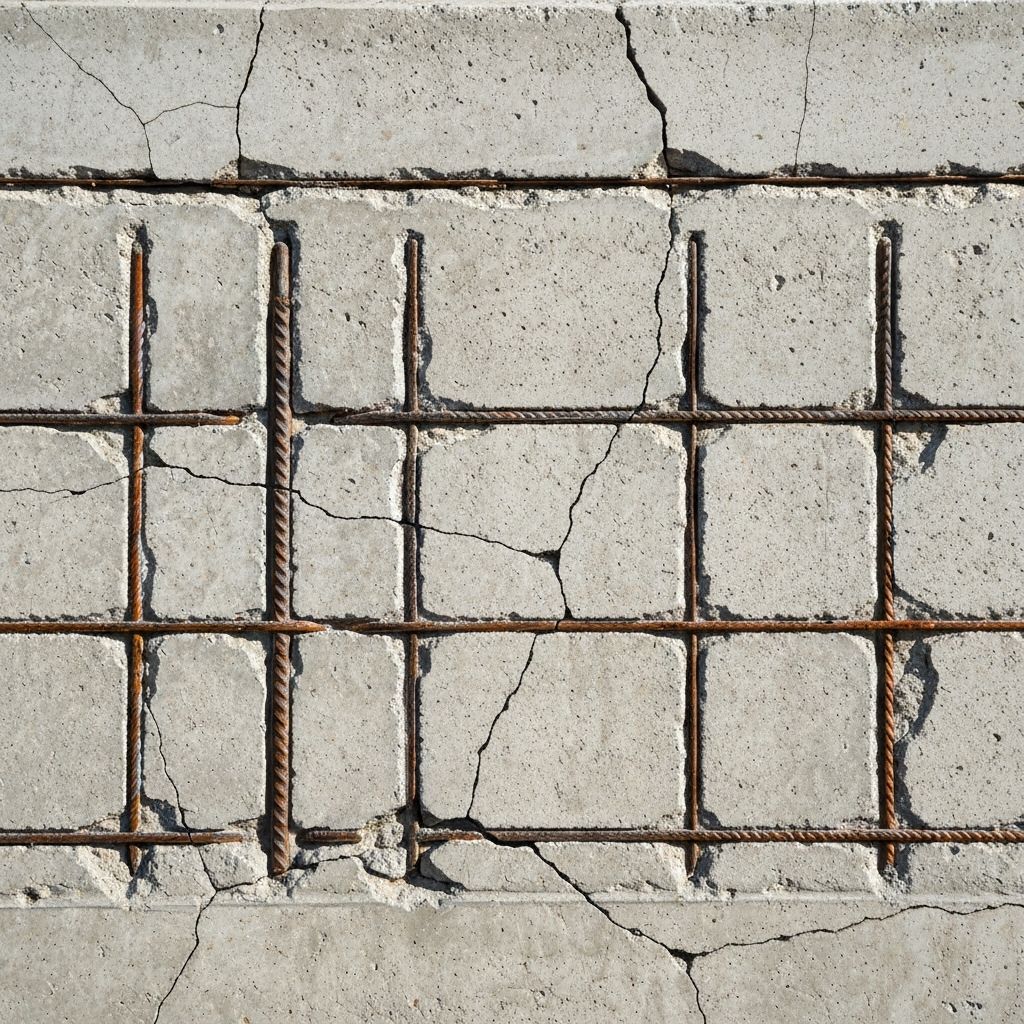
EN 1992-1-1 (Eurocode 2: Design of Concrete Structures—Part 1-1) establishes comprehensive procedures for assessing and designing punching shear resistance at critical zones where concentrated loads or reactions (typically column reactions) are transferred to slabs across a localized failure surface. Punching represents a distinctive failure mode in reinforced concrete slabs where a cone-shaped or pyramid-shaped fragment separates from the slab and lifts away from the surrounding structure, fundamentally different from beam shear failure. This critical failure mode commonly governs design of flat slabs, column-supported slabs, foundation slabs, and footings where concentrated loads from columns are transferred to the slab structure. EN 1992-1-1 provides standardized methods for calculating punching shear resistance based on control perimeter geometry, reinforcement configuration, concrete strength, column dimensions, and eccentric loading conditions. Understanding punching mechanics, control perimeter definition, shear resistance formulas, and reinforcement design requirements is essential for structural engineers designing slabs and foundations to ensure adequate punching capacity and prevent catastrophic local failure.
Punching Failure Mechanism and Control Perimeter Concept
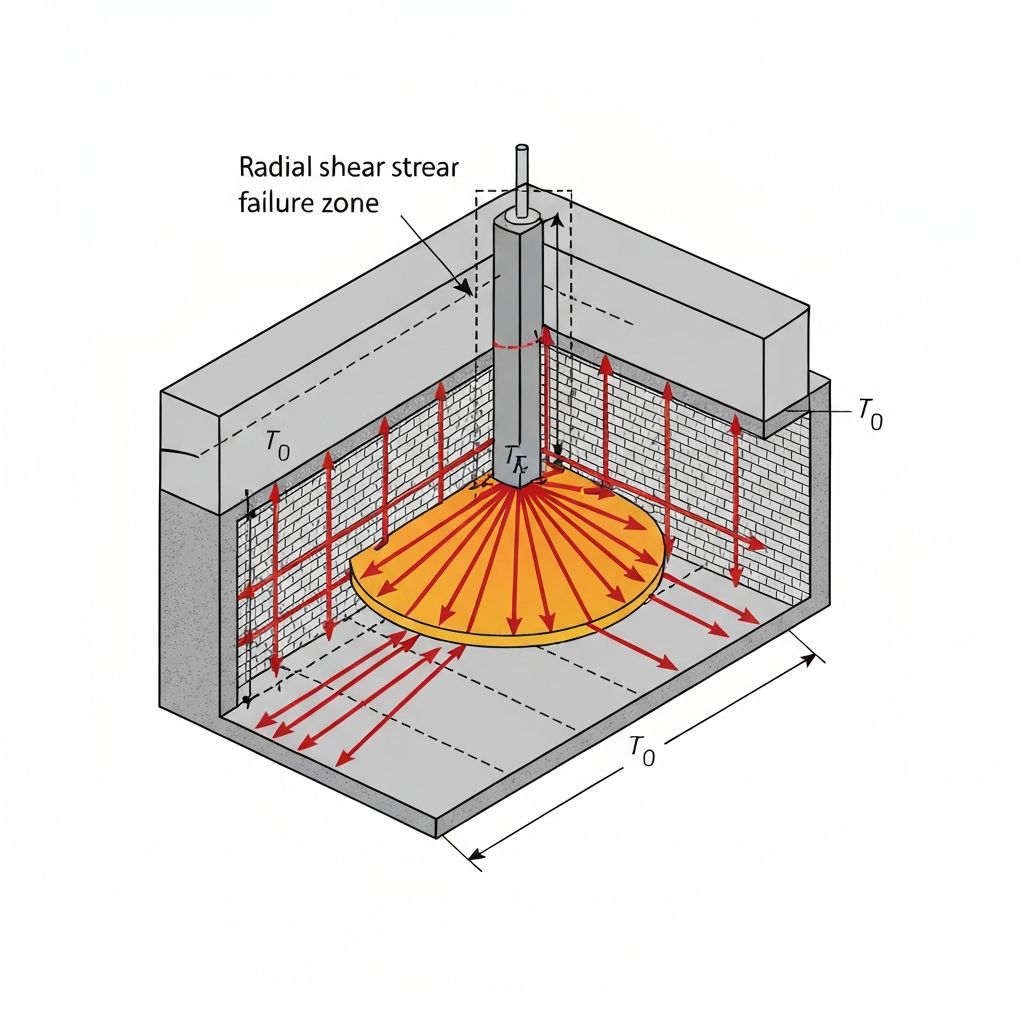
Punching failure represents a localized failure mode distinct from flexural or beam shear failure, where a concentrated load or reaction on a relatively small area (column, pedestal, or concentrated load) causes a cone- or pyramid-shaped volume of concrete and reinforcement to separate from the main slab. EN 1992-1-1 Section 6.4.1 establishes that punching failure is assessed at a control perimeter located at distance 2.0d from the loaded area perimeter, where d represents the mean effective depth of reinforcement. This control perimeter geometry reflects both research and field experience indicating that failure surface propagates outward at approximately 26.6° angle from the loaded area edge (defined by β = arctan(1/2)). The basic control perimeter U1 is constructed to minimize its total length while maintaining distance 2d from loaded area perimeter, with shape varying based on column geometry. At column faces, the maximum punching shear stress is checked; away from the column (at control perimeter), average shear stress distribution is evaluated. Where punching reinforcement is provided, multiple control perimeters are checked to determine the outermost perimeter Uout where reinforcement is no longer required. This multi-perimeter verification approach ensures both near-column regions and outer zones have adequate punching capacity.
Basic Control Perimeter Definition and Special Cases
EN 1992-1-1 Section 6.4.2 establishes that the basic control perimeter U1 is located at distance 2.0d from the loaded area perimeter for standard column conditions. For rectangular columns supporting uniformly distributed slab reactions, the control perimeter forms a closed path around the loaded area at constant distance 2d. For circular columns of diameter c, the basic control perimeter is a circle with radius equal to column radius plus 2d. The construction ensures minimized perimeter length to evaluate critical shear stress, based on principle that punching failure surface propagates radially outward at consistent angle from vertical. For loaded areas near openings (distance ≤6d from opening perimeter), that section of the control perimeter between tangent lines from the loaded area center to the opening outline becomes ineffective and is excluded from the perimeter calculation. For column-slab connections near slab edges or corners (distance ≤d from edge), special edge reinforcement is mandatory per Section 9.3.1.4 because concrete confinement is reduced and punching mechanics are altered. For slabs with variable thickness (such as footings with inclined underside), effective depth at the perimeter of the loaded area is used to define the control section. For enlarged column heads or capitals where head thickness significantly exceeds slab thickness, separate control sections are evaluated both within the head and in the slab to ensure adequate capacity throughout.
Shear Stress Calculation and Eccentric Loading Effects
EN 1992-1-1 Section 6.4.3 establishes the design procedure for punching shear, calculating design shear stresses along control perimeters. The basic design shear stress v_Ed at control perimeter is calculated as: v_Ed = V_Ed/(u_i · d) where V_Ed is design shear force at column perimeter, u_i is perimeter length being evaluated, and d is mean effective depth. For concentrically loaded columns, β = 1.0 and the design shear stress is uniform around the control perimeter. However, when unbalanced moments are transmitted from the slab to columns (common in flat plate structures with frame action), the shear stress distribution becomes non-uniform and maximum stresses occur on the perimeter section closest to the moment vector. EN 1992-1-1 provides the formula: β = 1 + k·(M_Ed/V_Ed)·(W_1/U_1) where k is a coefficient dependent on column aspect ratio c_1/c_2, M_Ed is unbalanced moment, W_1 is section modulus of perimeter defined as integral of distance-squared around the perimeter, and U_1 is basic perimeter length. For rectangular columns, values of k range from approximately 0.45 (for square columns c_1 = c_2) to 0.60+ (for elongated columns). For circular columns, β = 1 + 0.6π·e/(D + 4d) where e is moment eccentricity and D is column diameter. For edge columns with moment perpendicular to slab edge, reduced control perimeter U_1* is used in calculations. For corner columns, further reductions apply where eccentricity is toward the interior, reflecting reduced effective perimeter carrying shear stress.
Punching Shear Resistance Without Reinforcement—VRd,c
EN 1992-1-1 Section 6.4.4 establishes the design punching shear resistance of slabs without punching reinforcement (V_Rd,c) using the formula: V_Rd,c = (C_Rd,c·k·(100·ρ_l·f_ck)^(1/3) + k_1·σ_cp) · u_1 · d ≥ (v_min + k_1·σ_cp) · u_1 · d where C_Rd,c = 0.18/γ_c (approximately 0.12 for γ_c = 1.5), k = 1 + √(200/d) accounting for size effect (maximum 2.0), ρ_l is reinforcement ratio averaged over width equal to column width plus 3d each side, f_ck is concrete characteristic strength (in MPa, not exceeding C60/75 strength class impact on tension cutoff), k_1 = 0.1, σ_cp is mean compressive stress from applied loads and prestressing (positive for compression), and v_min is minimum shear capacity. This formula demonstrates that punching resistance increases with concrete strength (f_ck^(1/3) relationship), reinforcement ratio (ρ_l^(1/3) effect), and effective depth reduction. The size effect coefficient k reflects that smaller slabs have higher punching stress capacity per unit depth. Compressive stress σ_cp from prestressing or applied axial loads increases shear capacity by confining concrete and restricting crack propagation. The minimum shear capacity v_min = 0.035·k^(3/2)·f_ck^(1/2) ensures a baseline capacity even when reinforcement ratio is very low. For typical flat slab designs with C30/37 concrete, reinforcement ratio ρ_l ≈ 1.0%, and effective depth d ≈ 400 mm, V_Rd,c is commonly 400-600 kPa.
Punching Shear Resistance With Reinforcement—VRd,cs and VRd,max
EN 1992-1-1 Section 6.4.5 establishes the punching shear resistance when reinforcement is provided (V_Rd,cs) using: V_Rd,cs = 0.75·V_Rd,c + 1.5·(d/s_r)·A_sw·f_ywd,ef·sin(α)/(u_1·d) where A_sw is cross-sectional area of one shear reinforcement perimeter (mm²), s_r is radial spacing between successive perimeter rows (mm), f_ywd,ef is effective design strength of shear reinforcement = min(250 + 0.25d, f_ywd) [MPa], and α is angle between reinforcement and slab plane (typically 90° for vertical studs or links, or 45-60° for bent-up bars). The formula shows that shear capacity increases with reinforcement ratio (A_sw/s_r) and reinforcement strength, up to a maximum V_Rd,max adjacent to column: V_Rd,max = β·V_Ed ≤ (u_0·d·v_Rd,max)/(d) where v_Rd,max = 0.4·ν·f_cd and ν = 1 - f_ck/250 reduces capacity for higher-strength concretes. Maximum capacity u_0 is the enclosing minimum perimeter adjacent to column (for internal column, minimum periphery around loaded area; for edge columns, c_2 + 3d ≤ c_2 + 2c_1; for corner columns, 3d ≤ c_1 + c_2). The outermost perimeter where reinforcement is no longer required is calculated from: U_out = β·V_Ed/(V_Rd,c·d), with outermost reinforcement layer placed no more than 1.5d inside this perimeter. For single-line bent-down bar reinforcement, the ratio d/s_r in the reinforcement formula is conservatively given value 0.67.
Special Loading Conditions and Load Reductions
EN 1992-1-1 recognizes special conditions affecting punching design. For concentrated loads applied close to flat slab column supports, the shear force reduction permitted in 6.2.2 (for beam action) and 6.2.3 (for adjacent concentrated loads) is not valid and should not be included. This reflects that very localized column loads cannot be reduced by distributing to wider slab areas. For foundation slabs subject to soil pressure reaction, the punching shear force can be reduced by subtracting favorable upward soil pressure within the control perimeter, calculated as net applied force: V_Ed,red = V_Ed - (upward soil pressure - self-weight within perimeter). This reduction recognizes that soil pressure supporting the footing reduces net downward force creating punching stress. For post-tensioned slabs, vertical components of inclined prestressing tendons crossing the control section may be taken as favorable actions reducing punching shear stress where appropriate. For slabs where lateral stability does not depend on frame action between slab and columns, and where adjacent spans do not differ by more than 25% in length, approximate β values are permitted: approximately 1.5 for internal columns, 1.4 for edge columns, and 1.15 for corner columns. These simplifications avoid detailed calculation of moment eccentricity and perimeter properties when conditions are reasonably favorable.
Punching Verification Checks and Design Procedure
EN 1992-1-1 Section 6.4.3 establishes three checks that must be performed: (1) At column perimeter: V_Ed ≤ V_Rd,max to ensure shear stress does not exceed maximum capacity where concrete crushing governs; (2) At basic control perimeter U1: V_Ed ≤ V_Rd,c confirms whether punching reinforcement is required; and (3) If V_Ed > V_Rd,c, then punching reinforcement is designed so that V_Ed ≤ V_Rd,cs at critical control perimeter, and outermost reinforcement layer is placed no further than 1.5d within the perimeter where reinforcement is no longer required (U_out). For multiple control perimeters from different load cases or concentrated loads, each perimeter must be independently verified. The design procedure typically involves: (1) Determining V_Ed at column or loaded area from design loads; (2) Calculating control perimeter U1 at distance 2d from loaded area; (3) Computing V_Rd,c assuming no reinforcement using formula in 6.4.4; (4) If V_Ed ≤ V_Rd,c, no reinforcement required and design is acceptable; (5) If V_Ed > V_Rd,c, designing reinforcement layout and calculating V_Rd,cs using formula 6.4.5; (6) Verifying V_Ed ≤ V_Rd,cs and maximum capacity V_Ed ≤ V_Rd,max. This systematic approach ensures both serviceability and ultimate capacity are satisfied.
Punching Shear Reinforcement Detailing and Placement
EN 1992-1-1 Section 9.4.3 addresses detailing requirements for punching reinforcement. Reinforcement perimeters should be arranged in concentric rings around the loaded area, with radial spacing s_r between successive perimeters typically ranging from 0.6d to d depending on design calculations. Common reinforcement types include: (1) studs—short bolts or headed studs welded to reinforcing cage, anchored through concrete with headed ends to develop high shear capacity; (2) bent-up bars—bottom flexural reinforcement bent upward near column, typically at 45-60° angle to slab plane; (3) closed links or stirrups—continuous reinforcement loops wrapped around tension reinforcement to develop shear capacity. The first perimeter of reinforcement must be placed within distance 0.5d from column face (or 0.3d if closer placement can be achieved without congestion). When studs or links are used, multiple concentric perimeters create "baskets" of reinforcement concentrating around column. The effective height of shear reinforcement in the slab must be adequate to develop angle α between reinforcement and slab plane; minimum coverage requirements per Section 4.4 and spacing rules per Section 8.2 must be satisfied. For slabs near edges or corners where column is at distance ≤d from slab edge, special edge reinforcement in both directions perpendicular to edge is mandatory to develop anchorage and prevent local splitting failure at edge regions.
Eccentric Loading at Slab-Column Connections
Unbalanced moments commonly develop at slab-column connections in flat plate structures due to frame action, with one side of column in sagging (positive bending) and opposite side in hogging (negative bending). EN 1992-1-1 Section 6.4.3(3) addresses this non-concentric loading through the eccentricity factor β that increases shear stress distribution. The eccentricity e = M_Ed/V_Ed represents the moment-to-shear ratio; large moments relative to shear produce large eccentricities and highly non-uniform stress distributions. For internal columns with rectangular moment about one axis: β = 1 + 1.8·(e_y/b_y) where e_y is eccentricity along y-axis and b_y is perimeter dimension perpendicular to eccentricity, or approximately β ≈ 1.4-1.6 for typical flat slab connections. Maximum stress concentration occurs at the column face nearest to the bending moment direction (typically the reentrant corner). The moment must be transmitted through combination of: (1) shear stress variation around perimeter (described by β factor); (2) bending and torsion stresses in slab width equal to column width plus 3d. For columns located close to slab edges or corners, the reduced perimeter available to transmit moment increases stresses significantly; edge columns experience β ≈ 1.4-1.5 and corner columns β ≈ 1.15, with lower capacity due to smaller available perimeter. Designers must account for moment magnification effects through appropriate β factor selection based on column position and geometry.
Foundation Slabs and Concentrated Loads on Slabs
EN 1992-1-1 provisions for punching extend to foundation slabs and concentrated loads applied to slabs away from columns. For foundation slabs (footings), the design procedure at 6.4.4(2) provides special provisions recognizing that upward soil pressure within the control perimeter reduces net downward force: V_Ed,red = V_Ed - ΔV_Ed where ΔV_Ed is upward soil pressure minus self-weight of footing within the control perimeter. This reduction acknowledges that load path transfers through soil support rather than entirely through punching. For multiple concentrated loads on a slab (not at columns), each load must be checked independently; if loads are close together (center-to-center distance <4d), they may be combined into a single effective loaded area if within a control perimeter. At perimeter distances from column face (for various control sections within 2d), the resistance formula at 6.4.4(2) becomes: V_Rd = C_Rd,c·k·(100·ρ_l·f_ck)^(1/3)·(2d/a)^1.5 where a is distance from loaded area perimeter to control section being checked. This relationship shows resistance decreases for perimeters farther from the loaded area as punching cone propagates outward. For very thick footings with variable depth, the variable depth affects effective depths d_y and d_z at different locations around perimeter.
Partial Shear Force Transmission and Frame Stability
EN 1992-1-1 Section 6.4.3(6) recognizes that in structures where lateral stability does not depend on frame action between slabs and columns (such as buildings with separate bracing systems), and where adjacent spans do not differ by more than 25% in length, simplified β values may be applied instead of detailed calculation. The recommended simplified values (Figure 6.21N) are: β = 1.5 for internal columns, β = 1.4 for edge columns, and β = 1.15 for corner columns. These conservative values eliminate need to calculate moment distribution W_1 and aspect ratio coefficient k when conditions are favorable. However, in structures relying on flat-plate frame action for lateral stability (common in North America), more rigorous moment calculation and uneven shear distribution assessment are typically required because moment magnitudes and eccentric loading conditions are more critical. The partial shear force reduction provisions in 6.2.2 and 6.2.3 (reducing shear force near concentrated supports) explicitly do not apply at column-slab punching zones, ensuring full shear force is considered for punching checks regardless of distance to support.
Conclusion
EN 1992-1-1 provides rigorous procedures for assessing punching shear at slab-column connections, foundations, and concentrated load zones through systematic control perimeter evaluation and reinforcement design. Proper understanding of control perimeter geometry, resistance formulas, eccentric loading effects, and reinforcement detailing requirements is essential for safe slab design. VSG provides expert punching shear analysis, critical control perimeter verification, reinforcement design optimization, and Eurocode 2 compliance assessment for flat slabs, foundation systems, and slab structures. Contact our engineering team for detailed punching shear calculations, reinforcement detailing review, and comprehensive structural verification per EN 1992-1-1.
Related Testing Services
- Concrete Strength Testing
- Reinforcement Verification
- Slab Thickness Measurement
- Load Testing
- Deflection Monitoring
- Crack Assessment
Applicable Standards
Professional Engineering Support
This testing and verification work is part of comprehensive construction management and quality assurance services provided by our architectural and engineering consulting team. We support project management, quality control, and commissioning across military, nuclear, infrastructure, and commercial sectors.
Request Engineering Services