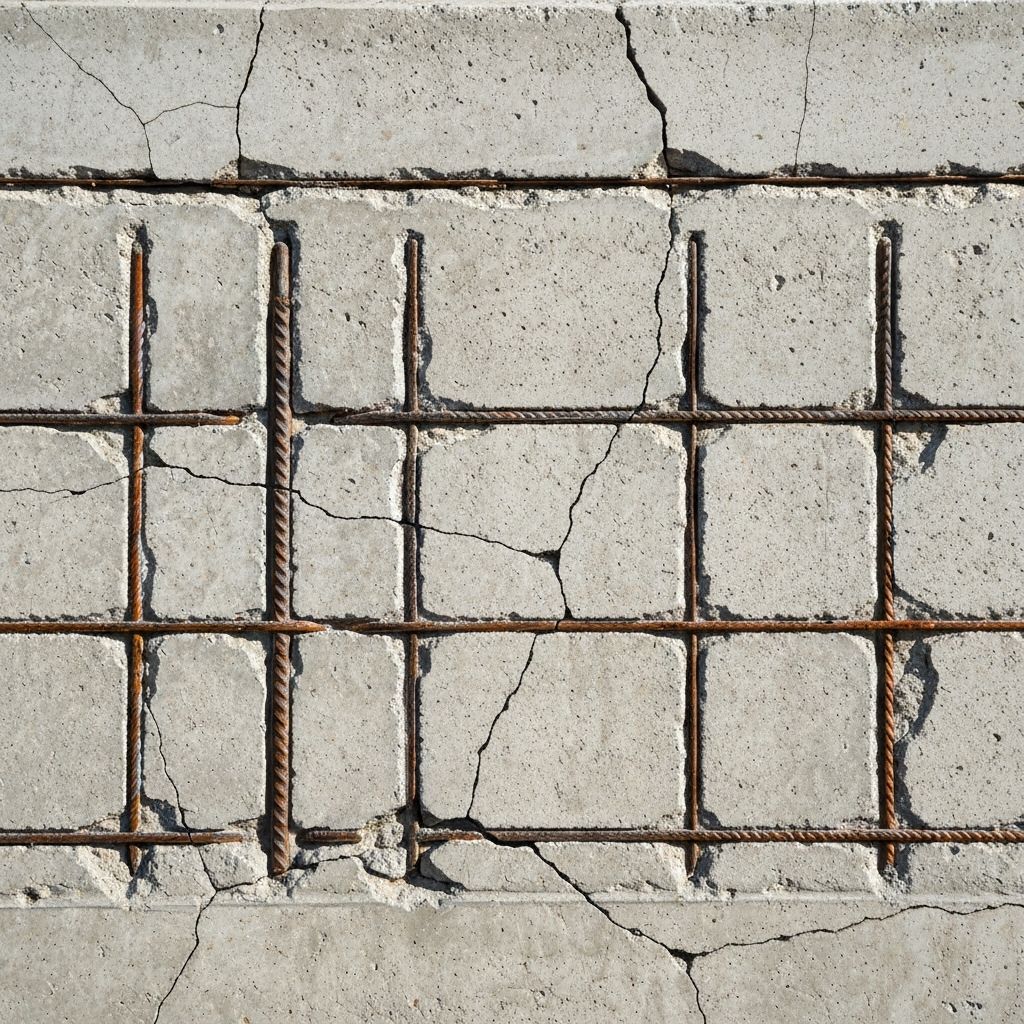
Crack control represents one of the most critical aspects of reinforced concrete design and construction, directly affecting the durability, aesthetic appearance, and long-term structural integrity of concrete structures. EN 1992-1-1 (Eurocode 2: Design of Concrete Structures—Part 1-1) Section 7.3 establishes comprehensive procedures for evaluating and controlling cracking at serviceability limit states, providing engineers with systematic methods to ensure structures remain uncracked or that crack widths remain within acceptable limits. Cracks in concrete may develop from multiple mechanisms including flexural tensile stress exceeding concrete tensile strength, restrained shrinkage deformations, restrained thermal deformations, early-age plastic shrinkage, or early-age thermal cracking. Understanding crack formation mechanisms through proper curing and appropriate concrete mix design strategies is essential for designing durable concrete structures. Reinforcement detailing plays a critical role in limiting crack widths and ensuring satisfactory serviceability performance throughout the structure's service life.
Cracking Mechanisms and Fundamental Causes
Concrete cracking develops when tensile stress exceeds the tensile strength of concrete or when deformations are restrained and induce tensile stress. EN 1992-1-1 recognizes that cracks may develop from multiple causes:
- •Flexural cracking—when bending moment induces tensile stress in concrete exceeding tensile strength, most common in beams and slabs
- •Shrinkage cracking—when drying shrinkage or autogenous shrinkage is restrained by reinforcement or structural geometry, producing internal tensile stress
- •Thermal cracking—when temperature changes, particularly early-age thermal cracking from hydration heat release or late-age cooling, induce tensile stress in restrained elements
- •Restraint cracking—when structural elements are prevented from free movement by fixed supports, continuity, or connections to other elements
- •Plastic shrinkage cracking—surface cracking occurring during initial setting when exposed surfaces dry rapidly before concrete gains sufficient tensile strength
Each mechanism operates on different timescales and produces different crack patterns, requiring tailored control strategies. Flexural cracking typically develops under sustained loading after concrete reaches design strength, while plastic shrinkage and early-age thermal cracking develop within hours or days after casting.
Classification of Concrete Cracks and Characteristics
Concrete cracks are classified by multiple criteria reflecting their origin and characteristics. By temporal development:
- •Plastic cracks—form while concrete is plastic and setting, including plastic shrinkage and settlement cracks
- •Early-age cracks—form during first days to weeks, typically from thermal or shrinkage effects
- •Service-life cracks—develop after concrete gains strength under sustained loads, environmental exposure, or cumulative deformations
By geometry and pattern:
- •Map cracking—fine, interconnected crack network resembling map segments, typically from uniform restraint
- •Radial cracking—cracks radiating from point loading or thermal gradients
- •Linear cracking—parallel cracks aligned with reinforcement or stress directions
- •Corner cracking—cracks originating at corners or edges where stress concentrations develop
By depth:
- •Surface cracks—limited to top 5-10 mm, cosmetic but permit water ingress
- •Through cracks—extend from surface to depth, permitting water and aggressive agents to reach reinforcement
- •Full-depth cracks—extend through entire section thickness
By cause:
- •Structural cracks—from design loads and moments
- •Non-structural cracks—from shrinkage, temperature, or plastic movements
Understanding crack classification assists in determining appropriate design and construction responses.
Serviceability Limit State Crack Control Philosophy
EN 1992-1-1 Section 7.3 establishes that crack control is verified at the serviceability limit state (SLS), representing conditions during normal use where functionality, appearance, and durability requirements must be satisfied. The design philosophy distinguishes between:
- •Controlling maximum stress to limit crack width—applicable when flexural cracks must remain thin to ensure protection of reinforcement and minimize water ingress
- •Providing minimum reinforcement to ensure bonded reinforcement prevents brittle failure—when tensile stress exceeds concrete strength, reinforcement controls crack distribution by forcing multiple small cracks rather than single wide crack
- •Preventing cracking entirely through design measures—by maintaining concrete stresses below tension strength or managing restrained deformations
The standard recognizes that avoiding all cracking is frequently uneconomical or impractical, particularly for long-span structures or heavily restrained elements. Instead, the focus is on ensuring cracks that do form are sufficiently numerous (multiple cracks dispersed across structure) and narrow (typically <0.3 mm for exposure to deicing agents, <0.4 mm for normal exposure) to prevent serious durability consequences. This pragmatic approach acknowledges that modern concrete structures can accommodate limited cracking if crack widths are controlled.
Environmental Exposure and Durability-Related Crack Control Requirements
The acceptable maximum crack width for a structure depends strongly on environmental exposure class per EN 206-1 and the corrosion risk posed to reinforcement. EN 1992-1-1 Section 4.4 and 7.3 establish that exposure conditions directly drive crack width limits and reinforcement quantity requirements. For exposure classes with no corrosion risk (XO—very dry conditions inside buildings), larger crack widths may be acceptable (0.4-0.5 mm) because no moisture or aggressive environment reaches concrete interior. For carbonation-induced corrosion exposure (XC classes—moderate humidity or cyclic wet-dry conditions), crack widths must be limited to 0.2-0.3 mm to prevent rapid carbonation progressing along crack faces to reinforcement. For chloride exposure (XD and XS classes—marine or deicing salt exposure), crack widths typically limit to 0.2 mm because chlorides directly penetrate through cracks without requiring carbonation, posing severe corrosion risk. The maximum w/c ratio and minimum cement content required to achieve adequate concrete cover quality also vary with exposure class; higher w/c ratios permit higher permeability and faster chloride/carbonation penetration, making crack control more critical. For severe exposures (XD3/XS3 tidal and splash zones), crack control is extremely rigorous because combination of direct salt spray and cyclic wetting/drying produces rapid corrosion even from thin cracks.
Three Approaches to Crack Control per Eurocode 2
EN 1992-1-1 Section 7.3 provides three distinct approaches to verify crack control:
- •Control without direct calculation—simplified design rules omitting crack width calculation, suitable for routine structures with well-understood behavior
- •Calculation of crack widths—detailed calculation predicting maximum crack widths based on stress, reinforcement properties, and concrete properties, required for critical structures or novel designs
- •Limiting stresses—controlling maximum flexural stress in concrete under SLS loading to remain below tension strength, preventing cracking altogether but typically more restrictive and uneconomical
The first approach involves ensuring minimum reinforcement provisions per Section 9.2.1, controlling bar spacing and diameter within prescribed limits, maintaining adequate concrete cover, and restricting maximum rebar sizes. This approach implicitly controls crack widths through empirical relationships between reinforcement ratio, spacing, and crack width—suitable for common concrete elements (beams, slabs, columns) with routine loading and exposure. The second approach, crack width calculation, uses formulas accounting for actual stresses, reinforcement properties (bar diameter, spacing, type), concrete quality, and environmental conditions to predict likely maximum crack width. This approach provides more precise control suitable for post-tensioned structures, structures subject to significant service-load stresses, or structures with unusually restrictive exposure conditions requiring crack width control <0.2 mm.
Fundamental Factors Influencing Crack Width and Propagation
Multiple material and structural factors influence whether cracks develop and how wide they become:
- •Concrete tensile strength—higher-strength concrete resists cracking better but also exhibits more brittle behavior with fewer small cracks rather than numerous fine cracks; strength classes <C40/50 tend to develop more distributed cracking while strength classes >C80/95 show more localized concentrated cracks
- •Reinforcement ratio and bar characteristics—higher reinforcement ratio provides more effective crack distribution by transferring stress to additional bars; finer bars (smaller diameter) and closer spacing both produce numerous small cracks rather than fewer wide cracks; however, excessive reinforcement increases congestion without proportional crack control benefit
- •Bar-concrete bond characteristics—deformed bars develop superior bond transferring stress to concrete compared to smooth bars, permitting effective stress distribution; bond characteristics depend on concrete surface quality, confinement from transverse reinforcement, and bar orientation
• Concrete cover—thicker concrete cover reduces crack width control effectiveness because cracks must cross larger distance before reaching reinforcement, permitting stress redistribution over longer length; minimum cover is typically limited by durability requirements rather than crack control
- •Effective depth and member dimensions—larger effective depths produce less stress concentration and wider stress diffusion around cracks; larger cross-sections also reduce early-age thermal and shrinkage stresses
- •Restraint conditions—fully restrained elements accumulate higher tensile stress from shrinkage or thermal effects than partially restrained or unrestrained elements; restraint from supports, continuity, and composite action increases cracking potential
Design Strategies for Crack Control: Material, Structural, and Construction Approaches
Effective crack control typically requires integrated strategy combining material selection, structural design, reinforcement detailing, and construction practices.
Material strategies include:
- •Concrete composition optimization—lower w/c ratios (≤0.50) reduce permeability and shrinkage, improving crack resistance
- •Cement type selection—low-heat Portland cements (CEM III, CEM IV) reduce hydration heat and early-age thermal cracking compared to high-C₃A cements
- •Pozzolanic additions—supplementary cementitious materials reduce drying shrinkage and improve crack control
- •Aggregate selection—properly graded aggregates with lower paste volume reduce shrinkage and cracking
Structural strategies include:
- •Member sizing—larger cross-sections reduce stress concentration and early-age thermal effects
- •Joint design—construction joints, control joints, and expansion joints accommodate shrinkage and thermal movements, reducing cracking in long or heavily restrained elements
- •Loading sequencing—staged loading and support release in post-tensioning systems reduce stress concentration
- •Restraint reduction—designing members to minimize external restraint from fixed supports or connections
Reinforcement strategies include:
- •Minimum reinforcement provisions—Section 9.2.1 requires minimum tension reinforcement to ensure crack distribution
- •Bar spacing control—limiting maximum spacing per crack control formulas
- •Distributed reinforcement—providing reinforcement throughout sections rather than concentrating at extreme fibers
- •Tension stiffening—relying on bonded reinforcement to bridge cracks and distribute stress
Construction strategies include:
- •Proper curing—maintaining concrete moisture and temperature during early-age hydration reduces plastic and early-age thermal cracking
- •Protection from rapid drying—using coverings, windbreaks, and fogging to prevent plastic shrinkage
- •Temperature control—shading against direct sun, cooling concrete ingredients, or ambient temperature management during heat waves
- •Formwork removal timing—delayed formwork removal reduces early stripping stresses
Minimum Reinforcement Requirements and Crack Distribution Control
EN 1992-1-1 Section 9.2.1 establishes that when flexural tensile stress would exceed concrete tensile strength, minimum bonded reinforcement must be provided to ensure cracking occurs as distributed multiple small cracks rather than single wide brittle failure. The minimum reinforcement ratio is calculated from:
A_s,min = k_c · k · f_ct,eff · A_ct / f_yk
where k_c accounts for stress distribution type, k reflects neutral axis position at SLS, f_ct,eff is mean concrete tensile strength, A_ct is effective tension area of concrete, and f_yk is reinforcement yield strength. This formula ensures that reinforcement force can develop at first cracking, controlling subsequent crack width. When minimum reinforcement is provided, initial crack forms at relatively low load, then additional cracks form at increasing loads rather than crack width widening excessively. The spacing between cracks becomes approximately proportional to bar diameter and cover—typical spacing for deformed reinforcement is 200-300 mm. Minimum reinforcement also addresses the serviceability requirement that reinforcement controls crack distribution, particularly important in post-tensioned members where bonded reinforcement must prevent large cracks in regions losing prestress.
Early-Age Cracking: Thermal Effects and Shrinkage Control Measures
Early-age cracking from hydration heat and plastic/autogenous shrinkage represents a distinct challenge requiring immediate attention during construction. Hydration heat generates internal temperature rises of 20-50°C (or higher in mass concrete) above ambient, creating thermal stress if the heated concrete is restrained. When temperature rises are non-uniform (interior hotter than surface), tensile stress develops in cooler exterior regions; if exterior restraint from formwork or adjacent cooler concrete limits expansion, cracking occurs. EN 1992-1-1 Section 10.3 addresses thermal stress in pretensioned elements, where thermal contraction after strand release induces stress reversal.
Control measures include:
- •Concrete composition—using lower-heat cements (Type IV or blended cement) reduces peak temperature and temperature gradient
- •Aggregate adjustment—using lighter-colored aggregates with lower thermal mass reduces temperature rise
- •Supplementary cementitious materials—fly ash or slag reduce heat of hydration
- •Concrete temperature management—cooling concrete ingredients (using ice, chilled water, or refrigerated aggregates) and placing during cooler times reduces initial temperature
- •Formwork timing—leaving formwork in place longer reduces cooling rate and temperature gradient between interior and surface, lowering thermal stress
- •Post-casting curing—wet burlap and insulating covers moderate cooling rates
- •Contraction joints—placing joints at intervals accommodates inevitable contraction without cracking concentrated at specific locations
Restrained Shrinkage and Long-Term Cracking Considerations
Drying shrinkage and autogenous shrinkage develop over extended periods, potentially inducing significant tensile stress if concrete is partially or fully restrained. Total shrinkage strains of 500-800 × 10⁻⁶ (0.5-0.8 mm per meter length) are typical for moderate-strength concrete in normal humidity environments; high-strength concrete may develop 300-600 × 10⁻⁶ strain. When a 10-meter slab or wall develops 500 × 10⁻⁶ shrinkage strain, free contraction would be 5 mm—if shrinkage is partially restrained by friction at base or connection to columns, internal tensile stress develops. EN 1992-1-1 recognizes restraint effects through Section 9.2.1.1 which requires minimum reinforcement to control shrinkage cracking in slabs, walls, and sections susceptible to restrained deformation. Typical minimum reinforcement percentages for shrinkage control are ρ_min = 0.26(f_ctm/f_yk) ≈ 0.003-0.005 for normal concrete.
Structural strategies to reduce restraint include:
- •Design of expansion/contraction joints—allowing free movement at predetermined intervals (typically 20-40 meters depending on member type)
- •Reducing restraint from connections—using flexible connections or bearings rather than rigid continuity
- •Composite action reduction—designing non-composite structures where possible to reduce mutual restraint
- •Two-way reinforcement—distributing reinforcement bidirectionally for slabs and walls to control cracking in both directions
Long-term monitoring of structures subject to significant restrained shrinkage may reveal progressive crack opening over years as sustained shrinkage continues—initial micro-cracks may widen as interior portions continue shrinking.
Inspection, Monitoring, and Acceptance Criteria for Cracks in Constructed Concrete
After concrete construction, systematic inspection and monitoring assess whether cracking remains within acceptable limits. Crack surveys typically employ visual inspection (recording crack location, orientation, and estimated width using pocket comparators or crack gauges), photographic documentation, and potentially advanced methods (ultrasonic scanning, thermography for embedded defects). EN 1992-1-1 provides guidance on crack assessment in Annex G, recognizing that some cracking is inevitable in reinforced concrete.
Acceptance criteria typically specify:
- •Crack width limits—maximum width acceptable depending on exposure class; structural cracks under design loads should not exceed specified widths (typically 0.3-0.4 mm)
- •Crack pattern—distributed cracking with numerous fine cracks acceptable; isolated wide cracks unacceptable
- •Crack extent—surface-only cracks may be tolerated; through-thickness cracks require investigation
- •Location—cracks in tension zones near reinforcement more serious than cracks near neutral axis
For acceptable cracks (within width limits, proper distribution, non-progressive), remedial action may not be necessary beyond monitoring. For unacceptable cracks (exceeding width limits, indicating structural distress, or progressive widening), remedial approaches include:
- •Epoxy or polyurethane injection—filling cracks to restore continuity and aesthetic appearance
- •Surface sealing—applying hydrophobic coatings to prevent water ingress
- •Structural repair—if cracks indicate insufficient reinforcement or design deficiency, reinforcement may be added
- •Monitoring—installation of crack gauges or displacement transducers to track whether cracks are stable or progressive
Conclusion
Crack control fundamentals in EN 1992-1-1 establish that effective management requires understanding cracking mechanisms, selecting appropriate control strategies, and implementing comprehensive material, structural, and construction measures. The standard recognizes that complete cracking prevention is typically uneconomical or impractical, instead focusing on limiting crack widths and ensuring cracking is distributed. Successful crack control requires integration of proper concrete composition, thoughtful structural design, appropriate reinforcement detailing, and careful construction practices including curing and temperature management. VSG provides comprehensive crack control analysis, structural assessment for cracking risk, and durability evaluation per Eurocode 2 requirements. Contact our engineering team for crack control strategy development, structural redesign consultation, or assessment of existing cracking in concrete structures.
Related Testing Services
- Concrete Tensile Strength Testing
- Crack Width Measurement
- Bond Strength Testing
- Concrete Permeability Testing
- Thermal Stress Analysis
- Shrinkage Measurement
Applicable Standards
Professional Engineering Support
This testing and verification work is part of comprehensive construction management and quality assurance services provided by our architectural and engineering consulting team. We support project management, quality control, and commissioning across military, nuclear, infrastructure, and commercial sectors.
Request Engineering Services