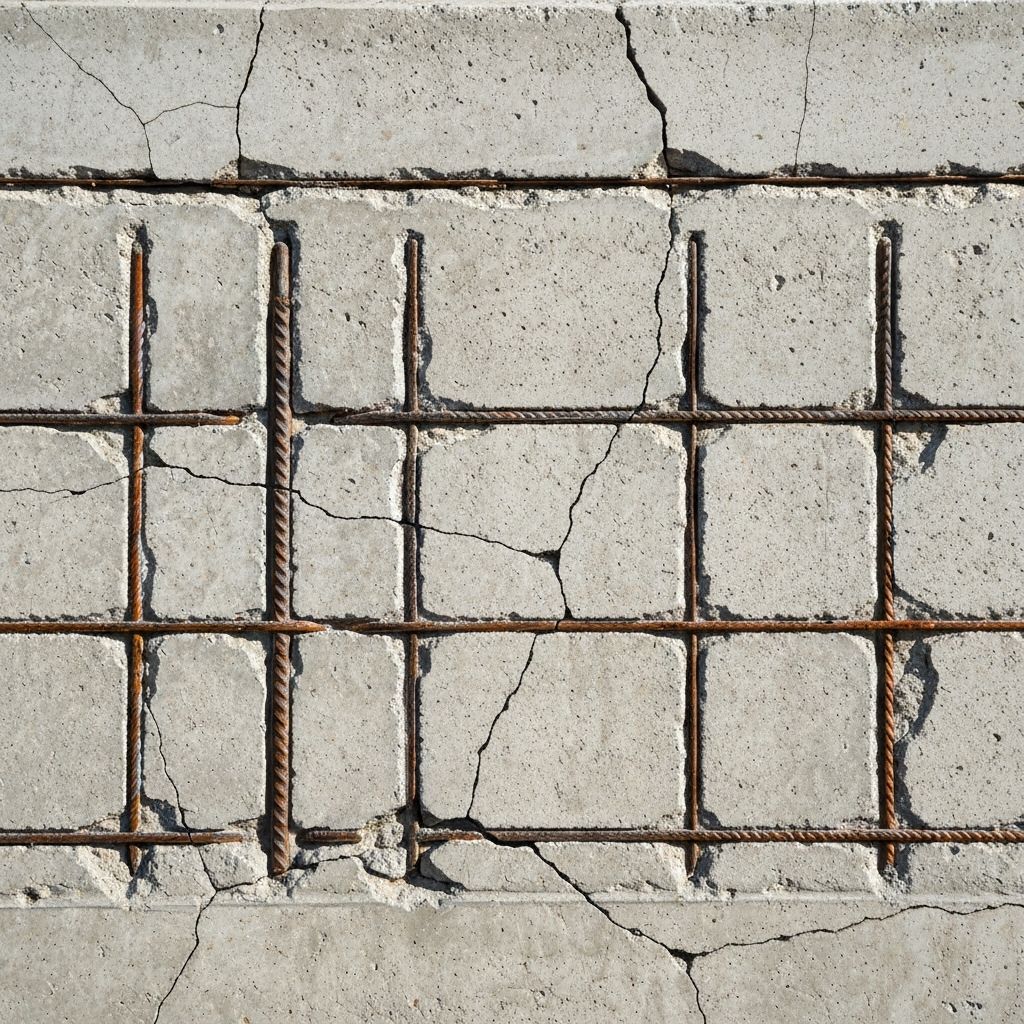
EN 1992-1-1 Section 7.3.4 provides comprehensive procedures for calculating maximum crack widths in reinforced concrete members, applicable when design requires explicit verification that cracks remain within specified limits. Crack width calculation replaces the simplified empirical approach with detailed mechanics-based analysis accounting for actual member stress, reinforcement properties, concrete quality, and environmental conditions. This approach is essential for post-tensioned members, structures in severe exposure environments (XD/XS classes), elements subject to significant service-load stress, or designs where maximum crack width must be verified for durability. The calculation procedure requires careful attention to input parameters—steel stress determination, reinforcement bond properties, concrete tensile properties, and cover dimensions—making quality assurance and construction verification critical to ensure calculated predictions align with actual performance. This article provides comprehensive guidance on crack width calculation methodology, parameter determination, formula application, and quality control procedures ensuring design assumptions remain valid through construction.
Crack Width Calculation Methodology and Design Formula
EN 1992-1-1 Section 7.3.4 provides the primary crack width calculation formula:
w_k = s_r,max · (ε_sm - ε_cm)
where:
• w_k is characteristic crack width (maximum expected width under service loads)
- •s_r,max is maximum crack spacing (distance between adjacent cracks)
- •ε_sm is mean strain in reinforcement at service loads
- •ε_cm is mean strain in concrete between cracks
The calculation requires determining crack spacing and strain conditions, then calculating their product to predict crack width. Quality assurance verifies that all input parameters are correctly determined from member properties and service loads.
The maximum crack spacing s_r,max depends on reinforcement bond characteristics and is calculated as:
s_r,max = k_3 · c + k_1 · k_2 · k_4 · Φ / ρ_p,eff
where:
• c is concrete cover to reinforcement center
- •Φ is reinforcement bar diameter
- •ρ_p,eff is effective reinforcement ratio (ratio of reinforcement area to effective tension area)
- •k_1 = 0.8 (for deformed bars), 1.6 (for smooth bars)
- •k_2 = 0.5 (for bending stress), 1.0 (for pure tension)
- •k_3 = 3.4, k_4 = 0.425 (codified coefficients)
The reinforcement strain ε_sm (strain in reinforcement at service stress) exceeds uncracked concrete strain due to cracking; concrete strain ε_cm (strain in concrete between cracks) reflects bond-dependent stress transfer from reinforcement to concrete bridging cracks.
Steel Stress and Strain Determination at Service Limit State
Accurate calculation of steel stress at service loads σ_s is essential for crack width prediction. Steel strain is calculated as:
ε_s = σ_s / E_s
where E_s = 200 GPa is reinforcement modulus. Steel stress is determined by elastic section analysis at service loads:
σ_s = M_s · (y_s - x) / (E_s · I_eff)
where:
• M_s is service moment (SLS load case)
- •y_s is distance from neutral axis to reinforcement
- •x is neutral axis depth (from elastic analysis)
- •I_eff is effective second moment of area
Practical determination of steel stress:
• Uncracked section analysis: assuming concrete contributes in tension (conservative for stress estimate, underestimating crack width)
- •Cracked section analysis: assuming concrete contributes no tension resistance (realistic for stress calculation after first cracking)
- •Typical results: cracked section stress 1.5-3 times higher than uncracked section stress depending on reinforcement ratio
Quality assurance verification of stress calculation:
• Design calculations must clearly show stress determination method and resulting value
- •Peer review confirms calculation method is appropriate for member configuration
- •If multiple stress cases exist (different loading conditions, member stages), highest stress case should govern crack width design
- •Construction quality control must verify reinforcement area matches design—any reduction from design area increases actual stress above predicted value, potentially increasing crack width above acceptable limits
Common design errors:
• Using uncracked section analysis (underestimating stress and underestimating crack width)
- •Omitting time-dependent stress increase from sustained loads and shrinkage
- •Using initial design stress instead of maximum service-load stress
Concrete Strain Components and Tension Stiffening Effect
Concrete strain between cracks ε_cm reflects the ability of concrete in tension to carry stress between cracks, termed 'tension stiffening.' The concrete strain is calculated using:
ε_cm = ε_sm - β · ε_p,eff
where ε_p,eff is effective prestrain (relating to reinforcement effectiveness in tension transfer) and β is a tension stiffening coefficient.
A refined expression for tension stiffening:
ε_cm = (σ_s - β · σ_ct · (1 + α_e · ρ_p,eff)) / E_s ≤ σ_s / E_s
where:
• σ_ct is concrete tensile stress at first cracking (mean tensile strength f_ctm typically)
- •α_e is ratio of reinforcement to concrete modulus (E_s / E_c ≈ 200 / 30 ≈ 6.7)
- •ρ_p,eff is effective reinforcement ratio
- •β accounts for load duration and stress history (β ≈ 0.5 for short-term loading, β ≈ 1.0 for sustained loading)
Tension stiffening effectiveness depends on:
• Reinforcement bond quality: deformed bars provide superior tension stiffening compared to smooth bars • Reinforcement ratio: higher reinforcement ratio increases tension stiffening effectiveness
- •Concrete cover: adequate cover permits stress transfer; inadequate cover reduces tension stiffening
- •Service stress level: at low stress, tension stiffening is significant; at high stress approaching yield, tension stiffening contribution diminishes
Quality assurance for tension stiffening:
- •Design should document assumptions regarding reinforcement bond quality and effective ratio
- •Construction quality control must verify actual conditions match design assumptions
- •If bond conditions are compromised (reduced cover, poor concrete quality, corroded reinforcement), actual tension stiffening may be less than predicted, resulting in wider cracks
Reinforcement Ratio and Effective Tension Area Determination
Effective reinforcement ratio ρ_p,eff is critical to crack spacing prediction, affecting calculated crack width proportionally:
ρ_p,eff = A_s / A_ct
where A_s is reinforcement area and A_ct is effective tension area of concrete section. Section 7.3.4 defines A_ct as the area of concrete within distance 1.5 · h_c,eff from extreme tension fiber:
h_c,eff = min(h_c, (h - x) / 3)
where h_c is distance from extreme fiber to neutral axis.
For common sections:
- •Rectangular beam in bending: A_ct typically includes full section width times effective depth for moderately reinforced sections
- •I-beam or flanged section: A_ct includes tension flange only
- •Wide slab: A_ct equals slab width times effective depth (b_eff · d)
- •Composite section with topping: A_ct must include contribution from both primary and secondary reinforcement
Practical effective ratio values for typical designs:
- •Lightly reinforced sections (ρ < 0.5%): ρ_p,eff ≈ 0.003-0.005, larger crack spacing, higher crack width risk
- •Normally reinforced sections (0.5% < ρ < 1.5%): ρ_p,eff ≈ 0.005-0.015, moderate crack spacing
- •Heavily reinforced sections (ρ > 2%): ρ_p,eff ≈ 0.015-0.030, small crack spacing, better crack distribution
Quality assurance procedures:
• Design calculations must clearly show effective area determination with section sketch indicating boundary of A_ct
- •A_ct calculation must follow code definitions precisely—common errors include using full section for flanged beams or incorrect boundary distance
- •Construction quality control verifies reinforcement area matches design (as variations affect ρ_p,eff directly)
- •If design permits reinforcement optimization, revised designs must recalculate ρ_p,eff to verify crack width remains acceptable
Concrete Cover and Bond Characteristics in Crack Spacing
Concrete cover directly affects crack spacing through the crack spacing formula component:
s_r,max = k_3 · c + k_1 · k_2 · k_4 · Φ / ρ_p,eff
The first term (k_3 · c = 3.4 · c) reflects that larger cover increases crack spacing because cracks must traverse larger concrete distance before reaching reinforcement. Practical implications:
- •Cover = 25 mm: s_r,max contribution from cover ≈ 85 mm
- •Cover = 40 mm: s_r,max contribution from cover ≈ 136 mm
- •Difference: 51 mm larger spacing from 15 mm thicker cover
Reinforcement bond characteristics significantly affect crack spacing through k_1:
- •Deformed bars (k_1 = 0.8): superior bond provides better crack distribution
- •Smooth bars (k_1 = 1.6): reduced bond increases crack spacing (2× effect)
Stress condition affects crack spacing through k_2:
- •Pure tension members (k_2 = 1.0): maximum crack spacing
- •Bending members (k_2 = 0.5): reduced crack spacing compared to pure tension
Quality assurance for bond and cover:
• Design calculations must document assumed cover thickness and reinforcement bond type (deformed vs. smooth bars)
- •Construction quality control must verify actual cover through measurements at 3+ locations per element
- •If actual cover deviates significantly from design (±10 mm typical tolerance), recalculation may be warranted
- •Reinforcement must match design specification (deformed grade 500 per EN 1992, not smooth bars)
- •If bond conditions are compromised (corrosion, contamination), effective k_1 may increase, increasing crack spacing and crack width
Common construction defects affecting crack width:
- •Insufficient cover reducing calculated s_r,max but compromising durability
- •Excessive cover increasing calculated crack spacing
- •Non-uniform cover across member creating localized wider cracks at thin-cover regions
Practical Crack Width Calculation Example
Consider a typical reinforced concrete beam subject to crack width verification:
Member description:
- •Rectangular beam section 400 mm wide × 600 mm depth
- •4 bars Ø20 mm grade 500 MPa reinforcement (A_s = 4 × 314 = 1256 mm²)
- •Concrete cover 40 mm (cover to reinforcement center c = 40 + 20/2 = 50 mm)
- •Concrete class C30/37 (f_ck = 30 MPa, f_ctm = 2.9 MPa)
- •Service moment M_s = 250 kNm
Step 1: Determine effective tension area:
- •Neutral axis position from cracked section analysis: x ≈ 210 mm
- •h_c = 600 - 210 = 390 mm
- •h_c,eff = min(390, (600-210)/3) = min(390, 130) = 130 mm
- •A_ct = 400 × 130 = 52,000 mm²
Step 2: Calculate effective reinforcement ratio:
- •ρ_p,eff = 1256 / 52,000 = 0.0242 ≈ 2.42%
Step 3: Determine steel stress from cracked section analysis:
- •Using cracked section: I_eff ≈ 14 × 10⁹ mm⁴ (for 4 Ø20 in 400×600 beam)
- •σ_s = 250 × 10⁶ · (600-50-210) / (200,000 × 14 × 10⁹) ≈ 192 MPa
Step 4: Calculate concrete strain (tension stiffening effect):
- •ε_cm = (192 - 0.5 × 2.9 × (1 + 6.7 × 0.0242)) / 200,000
- •ε_cm ≈ (192 - 1.5) / 200,000 ≈ 0.000952
Step 5: Calculate reinforcement strain:
- •ε_s = 192 / 200,000 = 0.00096
- •ε_sm - ε_cm = 0.00096 - 0.000952 ≈ 0.0000079 (strain difference due to cracking)
Step 6: Calculate maximum crack spacing:
- •s_r,max = 3.4 × 50 + 0.8 × 0.5 × 0.425 × 20 / 0.0242
- •s_r,max = 170 + 280 = 450 mm
Step 7: Calculate crack width:
- •w_k = 450 × 0.0000079 ≈ 0.0036 mm ≈ 0.004 mm (unrealistically small)
Note: This example illustrates procedure; actual calculations typically yield 0.2-0.4 mm for normal reinforced members depending on stress and reinforcement ratio.
Service Load Cases and Long-Term Crack Width Effects
Crack width calculation must consider multiple load cases and time-dependent effects:
Load cases requiring crack width verification:
- •Characteristic load case (SLS): maximum crack width under 1.0 × service loads (design case typically)
- •Quasi-permanent load case: permanent + sustained portion of variable loads (relevant for visibility and durability over structure lifetime)
- •Combinations relevant to exposure class: chloride environments (XD/XS) may require verification under sustained quasi-permanent loads
Time-dependent effects on crack width:
- •Immediate cracking: developing during first loading cycle
- •Progressive cracking: increasing from sustained load effects (creep of concrete in tension)
- •Long-term widening: shrinkage after first cracking continues widening existing cracks (concrete shrinkage increases strains while reinforcement doesn't shrink proportionally)
- •Fatigue effects: repeated loading cycles cause progressive damage and crack propagation
Quality assurance procedures:
• Design calculations must clearly identify load case (characteristic, quasi-permanent, or other) • If multiple load cases govern different aspects (maximum width vs. durability), calculations must verify both • Construction phase stress analysis should consider staged construction (temporary shoring, formwork removal, staged loading) which affects stress distribution and crack development timing • Long-term monitoring procedures may be specified for critical structures to verify that actual crack widths align with predictions
Time-dependent crack width calculation:
- •Design typically verifies immediate crack width under SLS loads
- •For long-term durability, additional widening from sustained load effects and long-term shrinkage may be estimated (typically 20-40% additional widening over years)
- •Structures with permanent or quasi-permanent significant loads (e.g., water pressure, sustained lateral earth pressure) warrant explicit consideration of time-dependent effects
Verification Against Acceptance Criteria and Remedial Procedures
After crack width calculation, verification determines whether predicted crack width w_k is acceptable:
Acceptance criteria specified in EN 1992-1-1 Annex G:
- •Exposure class XO (very dry, no corrosion risk): w_max ≈ 0.4-0.5 mm acceptable
- •Exposure class XC1 (moderate humidity): w_max ≈ 0.3 mm
- •Exposure class XC2/3 (cyclic wet-dry, moderate chloride): w_max ≈ 0.2-0.3 mm
- •Exposure class XD/XS (chloride exposure, marine/deicing salt): w_max ≈ 0.2 mm (stricter control required)
Verification procedure:
- •If calculated w_k ≤ w_max for applicable exposure class: design acceptable, proceed to detailing and construction
- •If calculated w_k > w_max: design modification required
Remedial procedures if calculated crack width exceeds limits:
- •Increase reinforcement ratio (add reinforcement): reduces ρ_p,eff in denominator of s_r,max, decreasing spacing and width
- •Reduce bar diameter: smaller bars directly reduce spacing component of s_r,max formula
- •Reduce bar spacing: closer spacing reduces width proportionally
- •Reduce concrete cover: thinner cover reduces spacing (trade-off with durability, must maintain minimum cover per Section 4.4)
- •Increase reinforcement grade (e.g., 600 MPa instead of 500 MPa): modestly improves tension stiffening
- •Increase concrete strength: higher strength provides modest improvement in tensile properties
- •Modify member dimensions: larger members reduce service stress
- •Reduce service loads: if loads can be reduced or redistributed, lower stress directly reduces width
Value engineering considerations:
- •Adding reinforcement is typically most cost-effective option (modest additional material cost, significant crack width reduction)
- •Changing bar diameter/spacing offers good value (can optimize labor and material simultaneously)
- •Reducing cover typically not recommended unless durability requirements permit
- •Increasing concrete strength provides modest benefit and increases material cost
Quality assurance for remedial design:
- •Modified designs must be recalculated through full procedure to verify new w_k meets limits
- •Construction specifications must clearly communicate all reinforcement changes
- •Construction quality control must verify modified reinforcement placement
Construction Implications and Quality Control for Crack Width Design
Crack width calculations depend critically on construction quality and compliance with design assumptions:
Critical construction parameters affecting crack width:
- •Reinforcement area: any reduction from design (due to substitution of smaller bars, reduced quantity, or missed installation) increases actual stress and crack width
- •Bar diameter: actual diameter must match design—using smaller bars increases actual spacing
- •Bar spacing: any increase from design increases actual spacing
- •Concrete cover: inadequate cover reduces calculated spacing and may compromise bond
- •Concrete strength: if strength is below specified f_ck, concrete tensile properties and tension stiffening effectiveness reduce
- •Concrete quality: w/c ratio, aggregate grading, and cement type affect concrete tensile strength and shrinkage characteristics
- •Early-age conditions: improper curing or early loading may induce cracks before concrete gains design strength
Construction quality control procedures:
Reinforcement verification:
- •Material certification confirming bar grade, size, and source
- •Shop drawing review confirming layout matches design
- •Pre-placement inspection of bar position and support (measurements at 3+ locations typical)
- •Spot checks of spacing (measured at multiple element locations)
- •Concrete cover measurement using cover meters (minimum 3 locations per element, ±10 mm tolerance)
- •Photographic documentation of reinforcement before concrete placement
Concrete quality verification:
- •Mix design review and approval before construction
- •Slump/workability testing confirming design specification compliance
- •Compression strength testing (7-day and 28-day) verifying f_ck achievement
- •Water-to-cement ratio verification (testing if required by specification)
- •Aggregate gradation confirmation
Curing and early-age management:
- •Temperature monitoring during early age (first 24-48 hours)
- •Curing duration and method per specification (wet burlap, coverings, curing compound)
- •Formwork removal timing—too-early removal causes stripping stresses increasing crack width
- •Observation for plastic shrinkage cracking during first hours
Post-construction inspection:
- •Visual inspection of completed surfaces for cracking
- •If cracks develop, measurement of crack width using crack gauge or photographic technique with scale
- •Documentation comparing observed crack widths to predicted design values
- •If observed widths exceed design predictions, investigation into cause (reinforcement placement, concrete quality, load variations)
Non-conformance procedures:
- •Minor deviations (spacing ±25 mm, cover ±5 mm, strength ≥95% of specified): typically acceptable without recalculation
- •Significant deviations (spacing ±50 mm, cover ±15 mm, strength 90-95% of specified): engineer evaluation; possible supplemental reinforcement or revised crack width calculation
- •Major deviations (missing reinforcement, wrong bar size, strength <90% of specified): requires corrective action—possible reconstruction or detailed assessment
Quality assurance documentation:
- •Design calculations retained for reference during construction
- •Inspection reports documenting all quality control verifications
- •Material test results (concrete strength, reinforcement properties)
- •As-built drawings reflecting actual construction (if variations from design exist)
- •Final acceptance report by engineer confirming compliance or identifying unresolved issues
Advanced Topics: Post-Tensioned Members and Composite Structures
Crack width calculation for post-tensioned members and composite structures involves additional complexity:
Post-tensioned members:
- •Prestress force reduces concrete tensile stress and service-load stress in reinforcement, typically resulting in smaller crack widths or elimination of cracking
- •Crack width calculation must account for prestress loss over time (friction loss at anchorages, elastic shortening, creep, shrinkage)
- •Bonded vs. unbonded tendons affect crack behavior: bonded tendons provide tension stiffening similar to reinforcement; unbonded tendons provide no tension stiffening
- •Service stress calculation must include prestress effects: σ_s = σ_applied_loads - σ_prestress,effective
- •Quality control must verify prestressing installation (force levels, tendon placement, grout/bond quality for bonded members)
Composite structures (concrete slab on steel beam):
- •Effective section includes both concrete and steel properties
- •Reinforcement ratio calculation must consider interaction between concrete reinforcement and steel section
- •Service stress depends on composite section properties and load distribution
- •Cracks typically develop in concrete slab first; steel section carries additional stress
- •Quality control must verify composite connection integrity
Quality assurance for advanced structures:
- •Crack width calculations for post-tensioned or composite members should be reviewed by engineer experienced in these systems
- •Construction must verify all assumptions regarding composite action, prestress loss, or special conditions
- •Long-term monitoring may be appropriate for complex structures to verify actual crack behavior matches predictions
Conclusion
EN 1992-1-1 crack width calculation provides systematic methodology for predicting maximum crack widths under service loads, essential for verifying durability and serviceability of reinforced concrete structures. Accurate calculation requires careful determination of input parameters, rigorous quality assurance during construction to ensure assumptions remain valid, and comprehensive verification that predicted widths meet acceptance criteria. VSG provides detailed crack width calculation services including design analysis, construction specification development, quality control procedures, and long-term monitoring support ensuring actual performance aligns with predictions. Contact our engineering team for crack width design verification, construction oversight, or remedial assessment of structures experiencing unacceptable cracking.
Related Testing Services
- Concrete Strength Testing
- Reinforcement Grade Verification
- Bar Placement Inspection
- Concrete Cover Measurement
- Crack Width Measurement
- Bond Strength Testing
Applicable Standards
Professional Engineering Support
This testing and verification work is part of comprehensive construction management and quality assurance services provided by our architectural and engineering consulting team. We support project management, quality control, and commissioning across military, nuclear, infrastructure, and commercial sectors.
Request Engineering Services