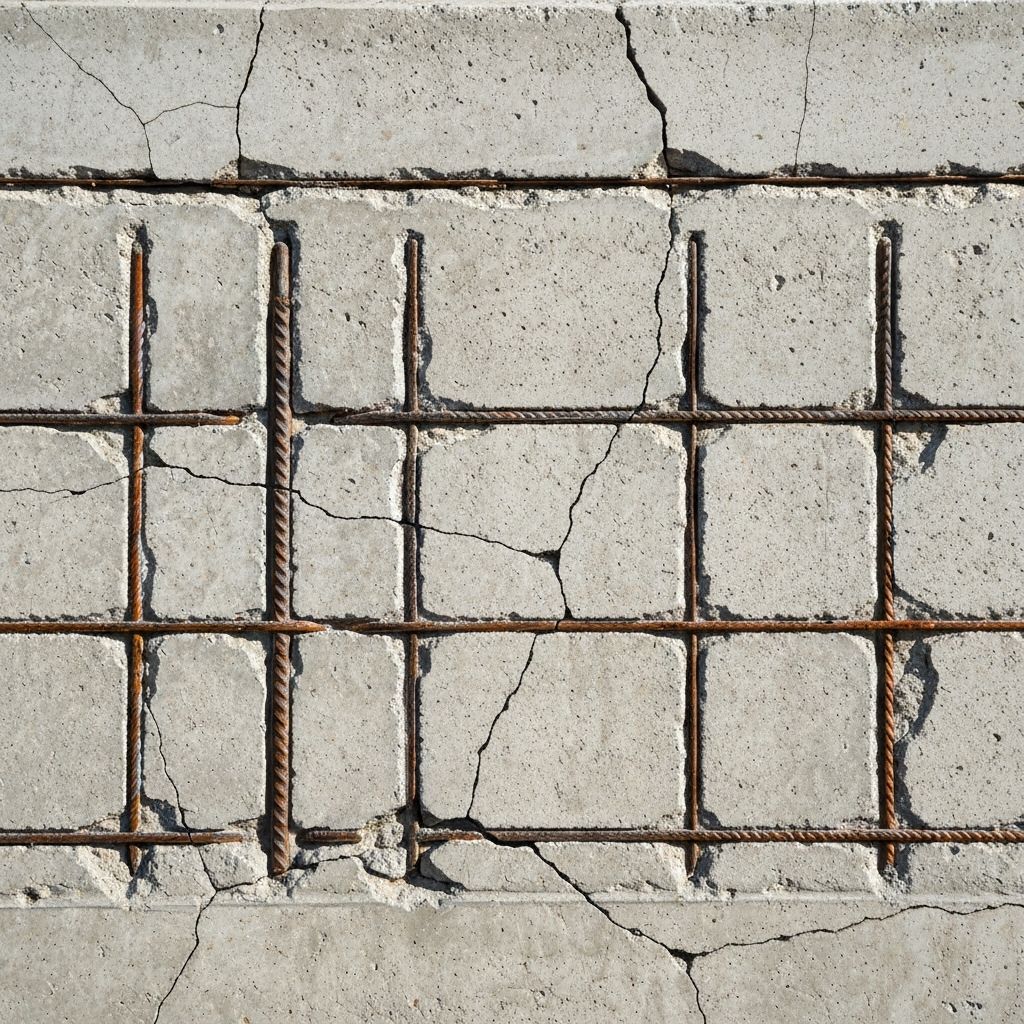
EN 1992-1-1 Section 7.3.3 establishes simplified design procedures for crack control 'without direct calculation,' providing engineers with practical alternatives to detailed crack width formulas for routine structures with well-understood behavior. This simplified approach is based on empirical relationships between reinforcement ratio, bar diameter, bar spacing, concrete strength, and crack width, codified through decades of research and practical experience. The simplified procedure eliminates the need for complex calculations while maintaining adequate safety margins, making it ideal for common structures (beams, slabs, columns) in normal exposure conditions. Quality control and construction procedures are essential to ensure simplified design assumptions remain valid—compliance verification during construction confirms that specified reinforcement, concrete properties, and detailing are properly implemented. This pragmatic approach balances design simplicity with construction economy, enabling designers to specify crack control requirements using standardized tables and rules accessible to construction teams with routine training.
Fundamental Requirements for Crack Control Without Calculation
EN 1992-1-1 Section 7.3.3 establishes that crack control without direct calculation is acceptable provided the following conditions are met:
- •Minimum reinforcement provisions are satisfied per Section 9.2.1, ensuring reinforcement area is adequate to control crack distribution
- •Bar diameter and spacing are limited to prescribed maximum values dependent on steel stress and concrete strength
- •Concrete cover meets minimum requirements per Section 4.4 and durability considerations
- •Reinforcement bond characteristics are adequate (deformed bars, proper anchorage, adequate surrounding concrete)
- •Load case is not unusual (normal service loads, standard member configuration, routine exposure)
- •Exposure class and durability requirements are clearly defined
This simplified procedure is most appropriate for:
- •Routine reinforced concrete elements with normal loading and support conditions
- •Members in exposure classes XO and XC (no corrosion or carbonation-induced corrosion)
- •Structures designed following standard procedures without unusual stress concentrations
- •Projects where design simplicity and construction economy justify empirical approach
The simplified approach should not be used when:
- •Structures are subject to unusual loading, restraint, or geometric conditions
- •Exposure involves chlorides (XD or XS classes) requiring very tight crack control (w_k < 0.2 mm)
- •Member undergoes significant service-load stress (post-tensioned members, composite structures with significant prestress)
- •Project requirements mandate explicit crack width verification
Quality assurance during design phase verifies that conditions permit simplified procedure; construction quality control ensures that specified requirements remain valid during installation.
Bar Diameter and Spacing Limitations: Design Tables and Practical Rules
EN 1992-1-1 Section 7.3.3 provides design tables 7.2 (expressions as alternatives to tables) specifying maximum bar diameter and spacing as functions of:
- •Steel stress at serviceability limit state (σ_s in MPa): typically 160-300 MPa for service loads on normal structures, obtained from stress calculation or approximation
- •Concrete strength class (f_ck): ranging from C20/25 through C80/95, with higher strength permitting larger bars and spacing
- •Exposure class and required maximum crack width (w_max): typically 0.3 mm for normal conditions (XC), 0.2 mm for harsh conditions (XD/XS)
For typical design cases:
- •At steel stress 160 MPa with C30/37 concrete in normal exposure (w_max = 0.3 mm): maximum bar diameter ≈ 20-25 mm with spacing 150-200 mm
- •At steel stress 240 MPa with C30/37 concrete in normal exposure: maximum bar diameter ≈ 12-16 mm with spacing 100-150 mm
- •At steel stress 280 MPa with C30/37 concrete in harsh exposure (w_max = 0.2 mm): maximum bar diameter ≈ 8-10 mm with spacing 50-100 mm
Practical construction rules based on codified relationships:
- •Smaller bar diameter always yields more favorable crack control (finer bars create more numerous cracks rather than fewer wide cracks)
- •Closer spacing always yields more favorable crack control
- •High concrete strength provides modest improvement in crack control
- •Design tables typically provide conservative values ensuring adequate safety margin
Value engineering optimization within simplified procedure:
- •Using largest permitted bar diameter and spacing minimizes reinforcement congestion and labor cost
- •However, designers must verify that larger bars remain within codified limits
- •Mixing bar sizes (some larger, some smaller) to achieve average spacing can reduce congestion while maintaining adequate control
- •Construction quality assurance must verify that actual bar diameter and spacing match design specification and remain within prescribed limits
Steel Stress Determination for Simplified Design
The simplified procedure requires determining steel stress at service loads (σ_s) to select appropriate bar diameter and spacing from design tables. Steel stress is typically calculated as:
σ_s = (M_s / (A_s · j_d)) · (f_yk / f_yk)
where M_s is service moment at SLS, A_s is reinforcement area, and j_d is lever arm from elastic section analysis. For routine design, simplified approximations include:
• Using uncracked section properties to estimate stress: σ_s ≈ M / (A_s · z) where z is lever arm ≈ 0.8-0.9 of section depth for normal ratios • For slabs, using unit moment method: σ_s ≈ M_L / (ρ · f_ck · d²) where ρ is reinforcement ratio • For standard member configurations (rectangular beams, one-way slabs), using industry-accepted approximations
Quality assurance procedures verify stress calculation:
• Design calculations must clearly document steel stress determination method and resulting value
- •Peer review confirms that stress estimate is reasonable for the member configuration
- •If design stress is uncertain or conservative assumptions warrant, using next-higher stress category from design table ensures adequate safety
Common construction errors in implementing simplified design:
- •Omitting stress calculation and assuming maximum stress value (overly conservative)
- •Using cracked section stress (overly high estimate) instead of service-load elastic stress
- •Failing to recalculate stress when design loads or reinforcement area change during value engineering optimization
- •Construction quality control must verify specified reinforcement area matches design, as stress calculation depends on actual area provided
Concrete Cover Requirements and Durability Protection
EN 1992-1-1 Section 4.4 establishes minimum concrete cover requirements that interact with crack control through multiple mechanisms:
- •Structural protection: adequate cover prevents spalling when cracks develop, maintaining structural integrity
- •Durability protection: adequate cover delays water and chloride penetration to reinforcement, reducing corrosion risk even if cracks exist
- •Bond development: sufficient cover and concrete surrounding reinforcement enable bond stress transfer to control crack width
- •Exposure class durability: cover requirements vary with exposure class—harsher exposures require thicker cover (25-40 mm typical minimum)
Minimum cover calculations per Section 4.4:
c_min = max(c_b, c_dur + Δc_dur - Δc_dev - Δc_st)
where c_b is reinforcement bar diameter, c_dur is durability cover from exposure class tables, and various reductions apply for superimposed protective measures.
For crack control, minimum cover guidance:
- •Thicker cover (35-40 mm) reduces crack width effectiveness because cracks must traverse longer distance before reaching reinforcement
- •Thinner cover (25-30 mm) improves crack width control but requires high concrete quality and careful construction
- •Quality assurance emphasizes that cover must balance durability protection (requiring adequate thickness) with crack control (benefiting from thinner cover)
- •Construction quality control verification includes cover measurement using cover meters at multiple locations per element, with minimum acceptable ±10 mm tolerance
Common construction defects affecting crack control:
- •Insufficient cover due to improper spacer placement or concrete flow during casting
- •Excessive cover from over-spacer use or poor vibration control
- •Non-uniform cover across element requiring reinforcement repositioning
- •Quality assurance procedures specify acceptable cover ranges and require corrective action for non-conformance
Control Joints and Expansion Joint Design for Restrained Structures
EN 1992-1-1 recognizes that many cracking problems, particularly in slabs and walls, arise from restrained shrinkage and thermal movement rather than service loads. Control joints (also called crack control joints or contraction joints) accommodate inevitable shrinkage, reducing stress concentration at specific locations rather than cracking distributed across the element.
Control joint design criteria:
- •Spacing: typically 20-40 meters for slabs depending on exposure (shorter spacing for high evaporation or high concrete strength), 10-20 meters for walls
- •Width: typically 15-25 mm to accommodate shrinkage strain (500-800 × 10⁻⁶ for typical concrete)
- •Depth: typically half to two-thirds of slab thickness to ensure crack initiates at joint location
- •Material: typically filled with joint material (cork, elastomer, etc.) or left as sawed/formed joint
- •Reinforcement at joints: reinforcement should NOT be continuous across joints; steel tie bars (small deformed bars) placed in top half of joint provide load transfer while permitting movement
Joint spacing calculation based on shrinkage strain:
Spacing = L_joint / (ε_cs + ε_temp) where ε_cs is shrinkage strain (500-800 × 10⁻⁶ typical), ε_temp is expected thermal strain range
For typical concrete with 500 × 10⁻⁶ shrinkage strain and 20 mm joint opening capacity: L_joint ≈ 20 mm / (500 × 10⁻⁶) ≈ 40 meters
Quality assurance for joint design:
• Design calculations must document assumed shrinkage and thermal strains • Joint spacing drawing details must be clear and accessible to construction teams • Joint dimensions (width, depth) must be specified to control crack initiation • Joint material specifications must ensure durability and functionality
Construction procedures for joint placement:
- •Formwork lines must be clearly marked for joint locations
- •Joint materials must be placed according to specifications
- •Concrete around joints must be properly vibrated and finished
- •If sawed joints (post-construction), timing is critical—sawing too early causes spalling; sawing too late permits random cracking
- •Quality control includes visual inspection of joint dimensions and material compliance before concrete cure completion
Reinforcement Detailing for Simplified Crack Control Design
Detailing requirements for simplified crack control include:
Bar placement and support:
- •Reinforcement must be positioned accurately within ±50 mm spacing tolerance typical for construction
- •Bars must be adequately supported to prevent movement during concrete placement
- •Cover must be maintained through spacers or rebar chairs at appropriate spacing
- •Concrete flow must not displace reinforcement
Bar continuity and splicing:
- •Bars should extend continuously through potential crack locations where possible
- •Lap splices should be located in low-stress regions (away from supports and load points)
- •Lap length must provide adequate bond development; for ribbed bars: l_d ≈ (σ_s / f_bd) · (Φ / 4) where f_bd is design bond strength
- •Splices should be staggered to prevent multiple bars terminating at same location
Anchorage at member ends:
- •Reinforcement must be adequately anchored to develop full design strength
- •Hook anchorage or extended bar embedment provides anchorage depending on member configuration
- •Design details must show anchor length clearly for quality control verification
Two-way reinforcement in slabs and walls:
- •Both directions must include minimum reinforcement to control cracking in both directions
- •Each direction separately subject to bar diameter and spacing limits from simplified design tables
- •Orthogonal layout must ensure reasonable aspect ratios (typically not exceeding 2:1 in spacing between perpendicular directions)
Quality assurance verification:
- •Design drawings must clearly show reinforcement details with dimensions, bar sizes, spacing, and cover
- •Shop drawings must be reviewed to confirm compliance with design intent
- •Construction photographs must document reinforcement placement before concrete casting
- •As-built drawings should be updated confirming actual placement matches design (or noting approved deviations)
Concrete Quality and Early-Age Crack Control
Concrete quality affects crack control through multiple mechanisms even in simplified design procedures:
Concrete strength and tensile properties:
- •Higher concrete strength typically improves crack control by providing higher tensile strength resisting crack initiation
- •However, higher-strength concrete exhibits more brittle behavior with fewer smaller cracks; strength classes >C60/75 typically require stricter design procedures
- •Mean tensile strength f_ctm from EN 1992-1-1 Table 3.1: f_ctm ≈ 0.30 · (f_ck)^(2/3) for normal concrete
- •Quality assurance verifies concrete strength through cube or cylinder testing per project specification
Water-to-cement ratio and durability:
- •Lower w/c ratio (≤0.50) reduces permeability and shrinkage, improving crack control and durability
- •Higher w/c ratio (>0.60) increases drying shrinkage and permeability, increasing crack development risk
- •EN 206-1 Section 5 specifies maximum w/c ratio for exposure classes (XO: 0.65, XC: 0.60, XD/XS: 0.45-0.55)
- •Quality assurance requires concrete mix design documentation and quality control testing of w/c ratio
Cement type and early-age thermal effects:
• Type I Portland cement (CEM I) generates significant hydration heat increasing early-age thermal cracking risk
- •Type III cement (CEM III, slag cement) or Type IV cement (CEM IV, fly ash cement) reduce heat of hydration
- •Early-age temperature management through extended curing reduces thermal stress and cracking
- •Construction procedures specify curing duration and curing methods (wet burlap, coverings, etc.)
Plasticity phase crack prevention:
- •Plastic shrinkage cracking occurs during first hours after casting when exposed surface dries rapidly
- •Prevention methods include: covering exposed surfaces, misting with water, providing windbreaks, applying curing compound
- •Construction workers must understand plastic shrinkage risk and implement protective measures in hot, dry, or windy conditions
Quality assurance for early-age crack control:
- •Concrete supplier must document mix design (w/c ratio, cement type, aggregate grading)
- •Concrete strength testing schedule confirms design strength is achieved (7-day and 28-day typical)
- •Construction procedures must include early-age curing requirements and worker training
- •Site inspection during critical early-age period (first 24-48 hours) verifies protective measures are implemented
Inspection, Verification, and Quality Control Procedures
Construction quality assurance for simplified crack control design includes:
Pre-construction phase:
- •Design review confirming simplified procedure is appropriate for project conditions
- •Specifications prepared documenting crack control requirements, material properties, detailing standards
- •Construction drawings produced showing reinforcement layout with bar sizes, spacing, cover, and details
- •Contractor planning confirms understanding of crack control requirements and identification of potential challenges
During construction—reinforcement phase:
- •Shop drawing review by engineer confirming reinforcement layout matches design
- •Material certification review verifying bar grade, size, and source
- •Pre-placement inspection of reinforcement position, support, and cover
- •Spot checks of reinforcement spacing (measured at 3-5 locations per element typical) confirming ±50 mm tolerance
- •Concrete cover measurement using cover meters at minimum 3 locations per element
- •Documentation through photographs showing reinforcement in place before concrete placement
During construction—concrete phase:
- •Concrete source verification and mix design compliance
- •Concrete placement monitoring for proper vibration and compaction
- •Early-age curing observation during first 24-48 hours
- •Temperature monitoring if early-age thermal cracking risk is significant
- •Formwork removal timing verification—too-early removal causes stripping stresses
Post-construction phase:
- •Visual inspection of completed surface for cracking
- •Crack width measurement if cracks appear (using crack gauge or photography with scale)
- •Documentation of crack pattern, location, and width for comparison to acceptance criteria
- •As-built drawing completion reflecting actual installation
Acceptance criteria and remedial procedures:
- •Reinforcement placement: spacing ±25 mm, cover ±10 mm acceptable; larger deviations require engineer evaluation
- •Concrete properties: strength testing must confirm f_ck is achieved (typically minimum 95% of specified strength acceptable)
- •Cracking: if surface cracks develop within acceptable width limits (<0.3 mm typical for normal conditions) distributed uniformly, often acceptable; isolated wide cracks (>0.4 mm) or concentrated cracks warrant investigation
- •Non-conformance: if reinforcement placement or concrete quality deviates significantly, supplemental verification through additional sampling, testing, or in-situ investigation may be required
Quality assurance documentation:
- •Inspection reports documenting all construction phase verifications
- •Material test results confirming concrete and reinforcement properties
- •Photographic records of key phases (reinforcement placement, concrete placement, early-age curing)
- •As-built drawings updated with actual conditions
- •Final acceptance report by engineer confirming compliance or identifying remedial requirements
Conclusion
EN 1992-1-1 simplified crack control procedures provide practical design framework for routine structures, eliminating complex calculations while ensuring adequate crack control through empirical reinforcement rules, detailed quality assurance, and construction procedures. Successful implementation requires clear design documentation, construction team understanding of crack control principles, and rigorous quality verification throughout construction. VSG provides design support for simplified crack control application, construction specification development, quality assurance documentation, and inspection oversight ensuring compliance. Contact our engineering team for crack control design guidance, construction procedure development, or inspection and verification services.
Related Testing Services
- Concrete Strength Testing
- Reinforcement Grade Verification
- Bar Placement Inspection
- Concrete Cover Measurement
- Crack Width Measurement
Applicable Standards
Professional Engineering Support
This testing and verification work is part of comprehensive construction management and quality assurance services provided by our architectural and engineering consulting team. We support project management, quality control, and commissioning across military, nuclear, infrastructure, and commercial sectors.
Request Engineering Services