Frost resistance testing is critical for materials exposed to freeze-thaw cycling in northern climates and wet environments. Concrete and masonry subjected to repeated freezing and thawing experience internal damage as water freezes and expands, creating stresses that deteriorate the material. Proper frost resistance requires appropriate air content, water-cement ratio, and material durability. This article provides detailed guidance on ASTM C666 and EN standards for frost resistance testing, comparing US and European requirements and highlighting critical parameters for material specification and acceptance.
Importance of Frost Resistance Testing
Freeze-thaw damage occurs when water penetrates into concrete or masonry pores, freezes (expanding 9% in volume), and creates internal stress exceeding material tensile strength. Repeated cycling progressively deteriorates the material through microcracking, spalling, and surface damage. Northern regions, coastal areas, and regions with winter de-icing salt face severe frost attack. Proper material specification with appropriate air content, low water-cement ratio, and supplementary cementitious materials provides durability for 50+ years. Inadequate frost resistance leads to premature failure, costly repairs, and shortened service life.
- Freeze-thaw cycles cause internal damage through ice crystal formation
- Water intrusion and capillary rise increase frost vulnerability
- Air voids protect concrete by providing space for ice expansion
- De-icing salts exacerbate freeze-thaw damage (salt scaling)
- Proper specification ensures 50+ year service life in harsh climates
- Inadequate frost resistance leads to costly repairs and failures
ASTM C666 Frost Resistance Testing (North America)
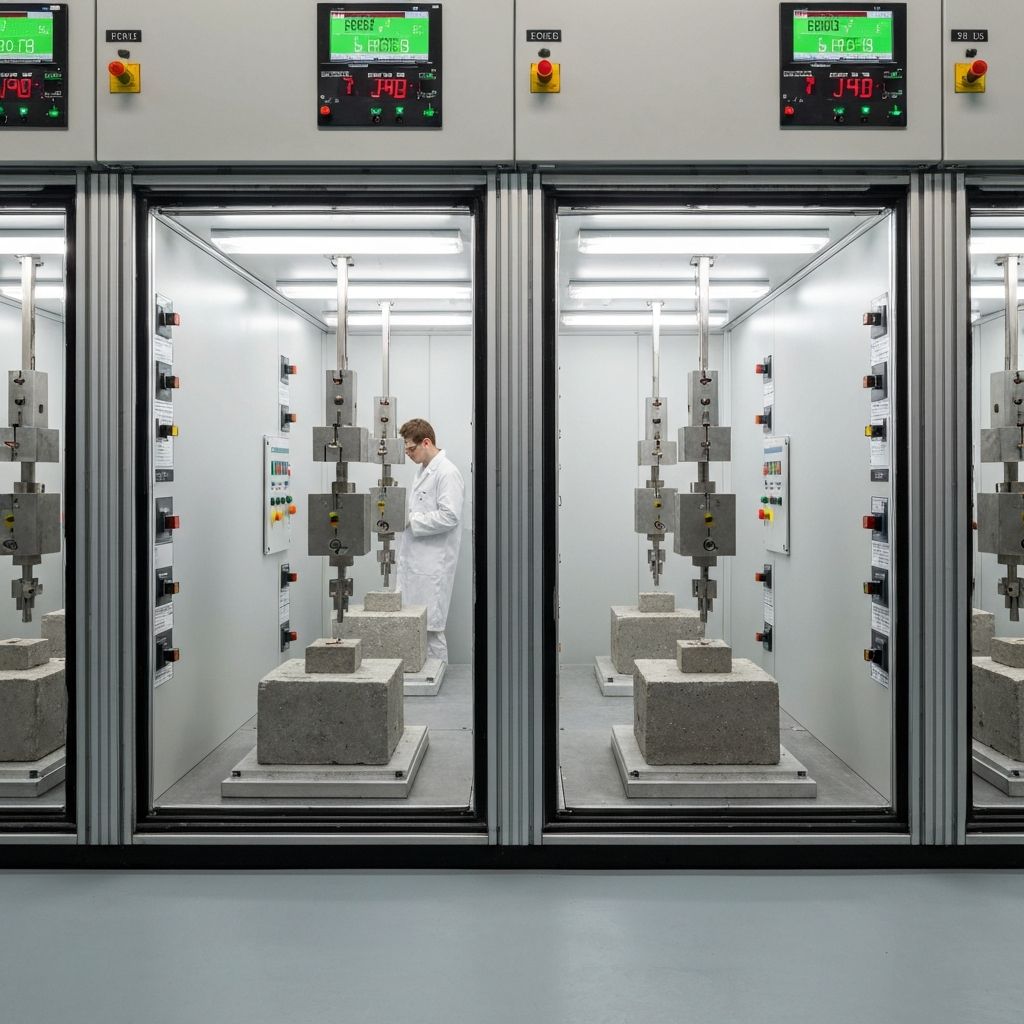
ASTM C666-15 specifies two procedures (A and B) for evaluating concrete's resistance to freezing and thawing. Procedure A involves rapid freezing in air and thawing in water (12 cycles per day, 16°C to -18°C). Procedure B uses freezing in water and thawing in air, representing more severe conditions. Concrete specimens are tested to measure dynamic modulus of elasticity (stiffness) and mass change. Test duration typically extends to 300 cycles (25 days for Procedure A). Specimens must maintain at least 60% of initial dynamic modulus and mass loss less than 5% to be considered acceptable. ASTM C666 correlates closely with field performance in cold climates.
- Procedure A: Air freeze (-18°C) and water thaw (25 cycles/day)
- Procedure B: Water freeze (-18°C) and air thaw (severe conditions)
- Test duration: Up to 300 cycles (standard commonly 300 cycles)
- Measurement: Dynamic modulus of elasticity every 30 cycles
- Acceptance: ≥60% initial dynamic modulus retained after testing
- Mass loss: Less than 5% mass loss acceptable
- Test specimens: 100x100x410mm prisms cast from test batch
- Temperature cycling: Rapid freeze (2-4 hours) and thaw (2-4 hours)
EN 12371 Frost Resistance Testing (Europe)
EN 12371-2010 specifies a freeze-thaw test procedure for natural stones but principles apply to concrete. The standard measures mass loss and appearance changes through repeated freeze-thaw cycles. Test conditions: specimens frozen to -12°C and thawed in water at 20°C. Typical test duration is 48 freeze-thaw cycles over 24 days. European standards emphasize durability class classification (F0, F1, F2, F3, F4) based on expected environmental exposure. Concrete exposed to freeze-thaw with de-icing salt requires F3 or F4 classification. Mass loss acceptance criteria typically less than 1-3% depending on material type and durability class. EN 12371 represents more moderate freeze-thaw intensity than ASTM C666 Procedure A.
- Test conditions: -12°C freeze, 20°C water thaw cycles
- Number of cycles: Typically 48 cycles (test duration 24 days)
- Measurement: Mass loss, visible deterioration, spalling
- Durability classes: F0 (no frost exposure) to F4 (severe exposure)
- Acceptance criteria: Mass loss <1-3% depending on durability class
- Test specimens: Cubes or prisms from stone or precast concrete
- Environmental exposure classification: Based on moisture and temperature
EN 1367-1 Frost Resistance Testing (Aggregates)
EN 1367-1-2007 specifies frost resistance testing for aggregates used in concrete and masonry. The test evaluates soundness of aggregate particles when subjected to freeze-thaw cycles. Test procedure: aggregate particles soaked in water, frozen at -17°C for 16-20 hours, then thawed in water at +20°C. Cycles repeated typically 6 or 12 times depending on durability requirements. Test measures mass loss of aggregate particles—particles that disintegrate or shed are removed after each cycle. Acceptance criteria: mass loss <5% for normal applications and <3% for severe frost exposure. EN 1367-1 ensures that aggregate particles themselves won't degrade in freeze-thaw service, which could lead to concrete deterioration.
- Purpose: Verify aggregate soundness in freeze-thaw cycles
- Test duration: 6 or 12 freeze-thaw cycles (3 or 6 days)
- Temperature: Frozen -17°C for 16-20 hours, thawed +20°C in water
- Mass loss measurement: After each freeze-thaw cycle
- Specimen size: Typical 10-25mm aggregate particles
- Acceptance: <5% mass loss for normal durability, <3% for severe
- Aggregate classification: F1 (normal), F2 (severe frost exposure)
- Critical for mountainous regions and de-icing salt environments
Air Content Requirements for Frost Resistance
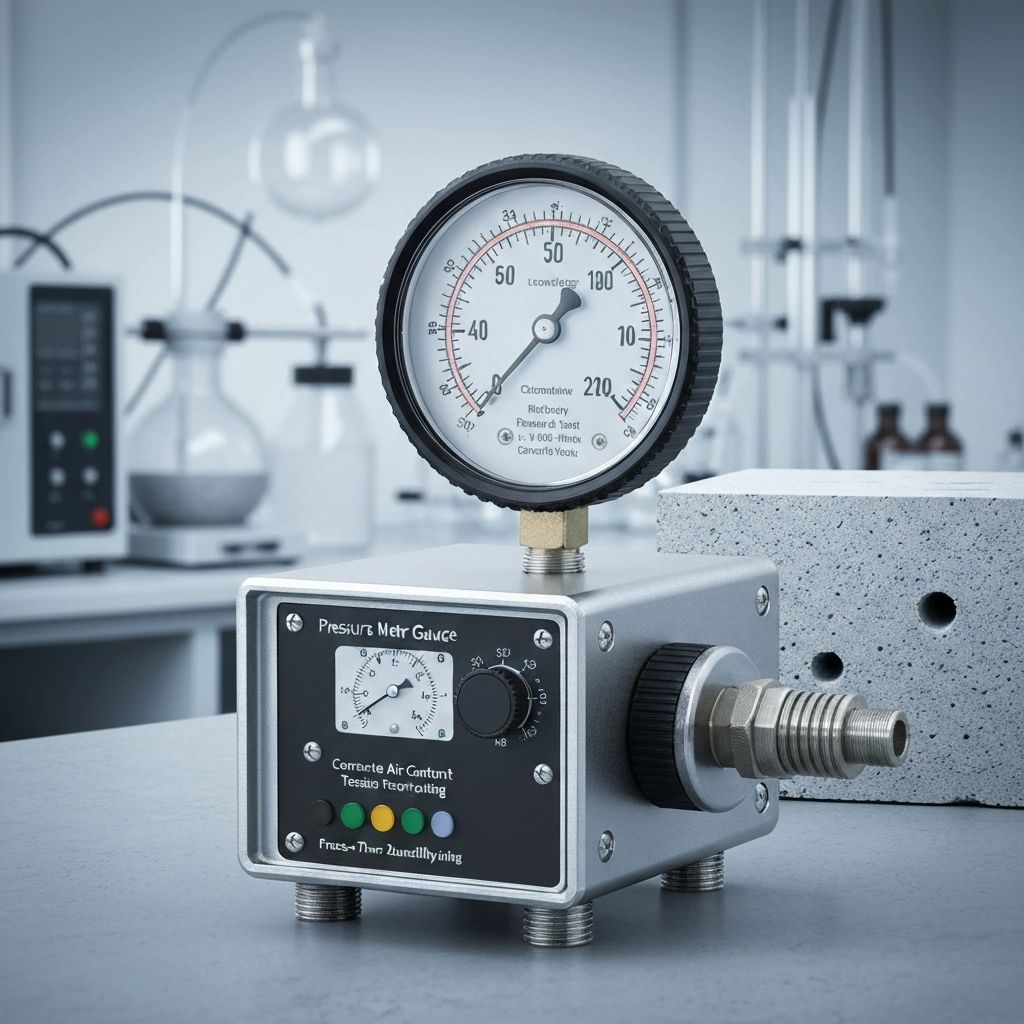
Air content is the most critical factor in concrete frost resistance. Entrained air voids (typically 250-500 micrometers diameter) provide space for water and ice expansion, relieving internal pressure that would otherwise cause damage. ASTM C666 requires minimum air content in test specimens (typically 4-8% depending on water-cement ratio and maximum aggregate size). EN 12371 concrete mix design typically includes 4-8% entrained air. Optimal air content balances frost protection with strength reduction (air voids reduce concrete strength 3-5% per 1% air). Under-air (insufficient air) leaves concrete vulnerable to frost damage. Over-air (excessive air) reduces strength and durability unacceptably. Proper air entrainment with air-entraining admixtures (typically 0.05-0.10% by cement weight) and careful quality control ensures consistent air content ±1.5% of target.
- Entrained air void target: 4-8% depending on exposure and max aggregate size
- Void size: 250-500 micrometers optimal for frost protection
- Spacing factor: ≤200 micrometers maximum distance between air voids
- Air-entraining admixture: 0.05-0.10% by cement weight typical dosage
- Strength reduction: Approximately 3-5% per 1% air content increase
- Durability enhancement: Approximately 2% air reduces frost damage by ~50%
- Quality control: Air content measured per ASTM C173 or EN 12350-7
- Specification requirement: Mix design must produce target air ±1.5%
- Testing frequency: Minimum one test per 100 cubic meters or daily
Comparison: US (ASTM C666) vs European (EN Standards) Requirements
Significant differences exist between ASTM C666 and EN testing standards affecting material specification and acceptance. ASTM C666 Procedure A uses more severe conditions (rapid -18°C freeze/thaw) compared to EN 12371 (-12°C). ASTM C666 specifies 300 cycle standard duration versus 48 cycles for EN 12371. ASTM acceptance criteria (≥60% dynamic modulus, <5% mass loss) are more demanding than EN criteria. These differences require careful specification when projects cross between US and European standards. For international projects or materials used in both markets, more stringent ASTM C666 Procedure A typically provides conservative specification meeting both standards.
- Temperature severity: ASTM -18°C vs EN -12°C (ASTM more severe)
- Cycle duration: ASTM 300 cycles vs EN 48 cycles (ASTM more extensive)
- Test duration: ASTM ~25 days vs EN ~24 days (similar calendar time)
- Acceptance criteria: ASTM ≥60% dynamic modulus vs EN <1-3% mass loss
- Air content: Both require 4-8% but testing methods differ slightly
- Field correlation: Both correlate to long-term freeze-thaw performance
- International projects: ASTM C666 more conservative specification
- EU/NATO projects: EN 12371 and EN 1367-1 typically required
- Specification strategy: Reference both standards for maximum durability assurance
Material Specification and Acceptance in Practice
Effective frost resistance specification combines concrete mix design requirements, air content verification, and demonstration testing. Mix design must specify: water-cement ratio ≤0.50 (or 0.55 with supplementary cementitious materials), minimum cement content, air-entraining admixture dosage, maximum aggregate size, and durability-related mix design per EN 206 or ACI 201. Air content must be verified during production (ASTM C173 or equivalent) minimum daily with results ±1.5% of specification. Demonstration testing (ASTM C666 or EN 12371) on trial batches proves compliance before production begins. Ongoing quality control testing continues throughout project ensuring consistent frost resistance. For severe exposure (de-icing salt environments or northern climates), specification of ASTM C666 Procedure A with ≥60% dynamic modulus provides maximum assurance.
- Water-cement ratio: Maximum 0.50 (0.55 with supplementary materials)
- Minimum cement content: Typically 360-380 kg/m³ for frost exposure
- Air-entraining admixture: Specified by dosage or target air content
- Supplementary materials: Fly ash, slag, silica fume enhance durability
- Maximum aggregate size: Typically 20mm or less for optimal air distribution
- Slump/flow: Maintained within narrow range for consistent air content
- Curing: Minimum 7 days moist curing essential for hydration completion
- Quality control: Daily air content testing, weekly strength verification
- Demonstration testing: ASTM C666 or EN 12371 on approved mix design
US vs European Project Requirements Summary
North American projects (USACE, DoD, etc.) typically specify ASTM C666 Procedure A with acceptance of ≥60% dynamic modulus after 300 cycles. Air content specification ranges 4-8% depending on maximum aggregate size and exposure. European/NATO projects specify EN 12371 with durability class F3 or F4 for harsh climates, requiring <1-3% mass loss after 48 cycles. UK/EU projects may reference BS 8500 specifying BRE/BV durability index. Both standards require aggregate testing per EN 1367-1 (Europe) or ASTM C88 (North America). International or complex projects often reference both ASTM and EN standards with specifications meeting the more stringent requirement. Project locations in border regions or serving multiple markets benefit from dual specification ensuring compatibility across standards.
- North America: ASTM C666 Procedure A is industry standard
- Europe: EN 12371 with durability class classification standard
- NATO projects: Often specify both ASTM and EN standards
- Defense/Military: USACE specifies ASTM C666, DoD may allow EN equivalency
- Infrastructure: High-speed rail and airports often specify European standards
- International: Dual specification ensures market acceptance in both regions
- Aggregate: ASTM C88 (North America) vs EN 1367-1 (Europe)
- Air content: EN 12350-7 (Europe) vs ASTM C173 (North America)
Conclusion
Frost resistance testing through ASTM C666 or EN standards ensures durable concrete and masonry in freeze-thaw environments. Proper air content (4-8%), low water-cement ratio (≤0.50), and appropriate cementing materials provide long-term performance. VSG provides frost resistance testing, material durability consulting, and quality assurance for projects in harsh climates. Contact our team to specify appropriate frost resistance testing for your project's geographic and environmental exposure.
Related Testing Services
- Air Content Testing
- Concrete Compressive Strength Testing
- Water Absorption Testing
- Aggregate Soundness Testing
- Scaling Resistance Testing
Applicable Standards
Professional Engineering Support
This testing and verification work is part of comprehensive construction management and quality assurance services provided by our architectural and engineering consulting team. We support project management, quality control, and commissioning across military, nuclear, infrastructure, and commercial sectors.
Request Engineering Services